Cloud-Based IoT Early Warning System: Building Real-Time Monitoring and Automated Alert Solutions
Introduction
In today's connected world, businesses increasingly depend on real-time data to monitor operations, identify unusual events, and make informed decisions. However, when monitoring systems rely on manual tracking or disconnected devices, important information can be delayed, operational visibility becomes limited, and responding to critical events becomes more challenging.
A cloud-based IoT Early Warning System helps address these challenges by connecting IoT devices, collecting real-time sensor data, monitoring events, and generating automated alerts through a centralized platform.
At Fusion Trail Solutions, we developed a Cloud-Based IoT Early Warning System designed to improve monitoring accuracy, reduce response delays, and provide better visibility into critical events. The platform combines IoT sensor integration, cloud infrastructure, real-time analytics, and automated notifications into one centralized solution.
This case study explores the development approach, technical architecture, challenges, and solutions behind the project.
1. Understanding the Project Requirements
The primary objective was to build a centralized IoT monitoring platform capable of collecting data from connected devices and helping users identify important events in real time.
Instead of depending on manual monitoring, the system was designed to support automated event tracking and early warning notifications.
The platform needed to provide:
Real-time data collection from connected IoT devices.
Centralized sensor monitoring.
Automated early warning alerts.
Real-time analytics and reporting.
Device management capabilities.
Cloud-based data synchronization.
The goal was to create a connected monitoring environment where users could access relevant information through a centralized analytics dashboard.
2. Key Challenges We Addressed
Developing a reliable IoT monitoring solution requires more than connecting devices. The system must also handle communication, data collection, event monitoring, and timely notifications.
During the project, we focused on four major challenges.
Delayed Warning Notifications
When important events are not detected or communicated quickly, response activities can be delayed. The platform needed an automated alert mechanism to improve how warning notifications are generated and delivered.
Lack of Centralized IoT Monitoring
Monitoring connected devices through separate systems can make it difficult to maintain a clear operational overview. A centralized platform was required to bring monitoring information together.
Manual Event Tracking
Manual tracking can increase operational effort and make it harder to identify important events consistently. The solution needed automated event monitoring to reduce dependence on manual processes.
Limited Real-Time Analytics
Without accessible real-time information, users may struggle to understand monitoring conditions and identify relevant changes. The system needed an analytics dashboard to improve visibility into collected data.
3. Our Development Approach and Solution
To address these challenges, Fusion Trail Solutions developed a cloud-based IoT monitoring platform that combines sensor integration, automated alerts, backend services, and centralized analytics.
The solution was planned around four important development areas.
Cloud-Based IoT Monitoring Platform
We developed a centralized monitoring environment to collect and manage information from connected IoT devices. This provides a unified view of device activity and monitoring data.
Automated Early Warning Alerts
The system incorporates automated alert functionality to help identify important events and communicate warnings without relying entirely on manual tracking.
Real-Time Analytics Dashboard
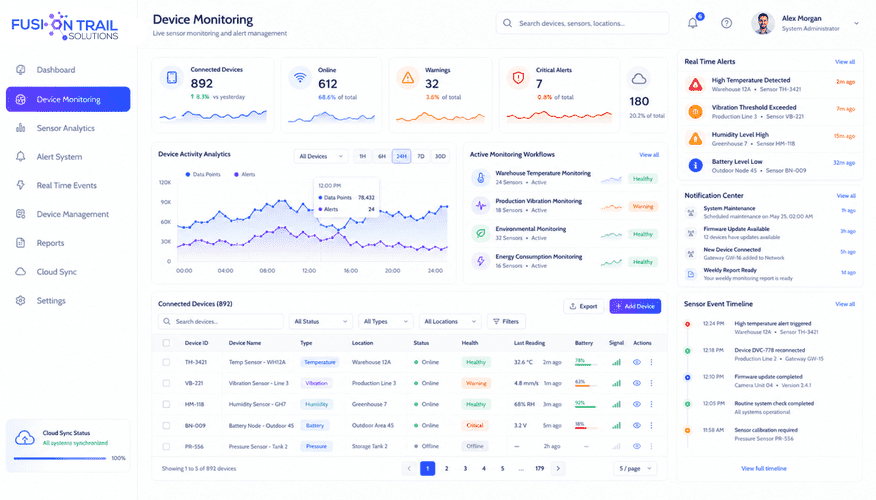
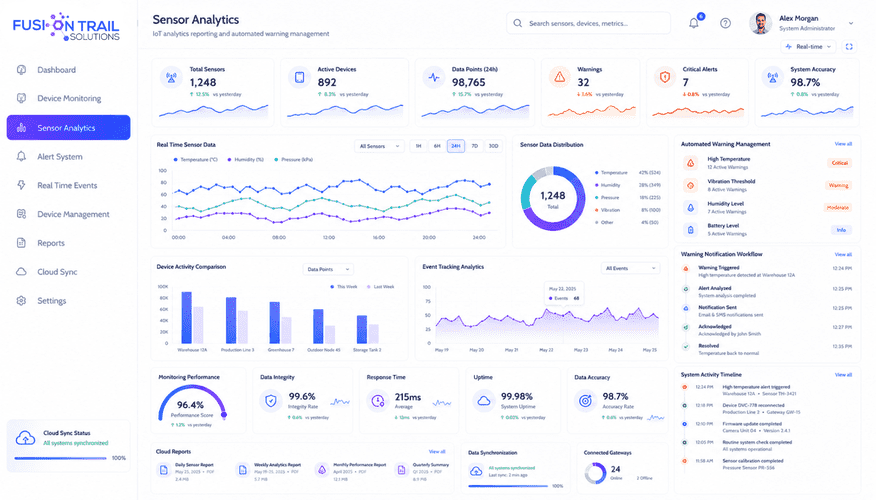
A frontend analytics dashboard provides a centralized interface for monitoring information and accessing relevant reporting. It helps users understand system activity and improve operational visibility.
Sensor Integration System
The sensor integration layer supports communication between connected devices and the platform, allowing monitoring information to be collected and processed through the system architecture.
4. Core Features of the Platform
The platform was developed with several essential features to support IoT monitoring and early warning workflows.
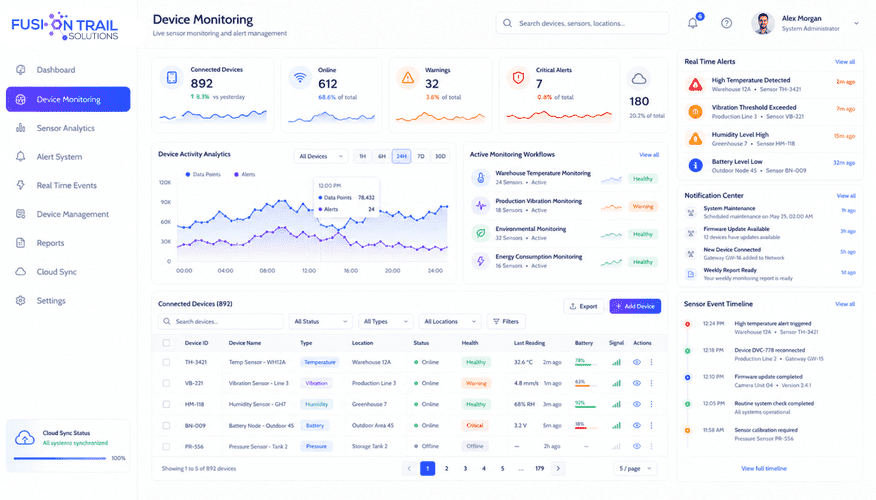
Sensor Monitoring: Enables centralized monitoring of connected sensors and their collected information.
Real-Time Alerts: Supports automated warning notifications for important monitoring events.
Data Analytics: Helps users review monitoring information through an analytics-focused environment.
Device Management: Provides functionality for managing connected IoT devices within the platform.
Dashboard Reporting: Presents monitoring information through a centralized dashboard and reporting interface.
Cloud Synchronization: Supports cloud-based synchronization to maintain a connected monitoring environment.
Together, these features create a more organized approach to monitoring connected devices and managing important events.
5. Technology Stack and System Architecture
Selecting the right technology stack was an important part of developing the platform. The architecture needed to support frontend monitoring, backend processing, IoT communication, data management, and cloud infrastructure.
The project used the following technologies:
React: Used to develop the frontend analytics dashboard and user interface.
Python: Supported backend development and application logic.
FastAPI: Used to build backend services and API communication.
MQTT: Provided the communication layer for IoT messaging.
PostgreSQL: Used for structured data management.
AWS IoT: Supported the cloud-based IoT infrastructure.
Docker: Supported application containerization and deployment workflows.
How the Architecture Works
The system architecture consists of four main layers:
1. Frontend Analytics Dashboard
The React-based frontend provides users with a centralized interface to access monitoring information, analytics, and reports.
2. MQTT Communication Layer
MQTT serves as the IoT communication layer, supporting messaging between connected devices and the platform.
3. FastAPI Backend Services
Python and FastAPI power backend services responsible for application functionality and communication between system components.
4. Cloud-Hosted IoT Infrastructure
AWS IoT and the cloud infrastructure support the connected monitoring environment, while PostgreSQL provides structured data storage and Docker supports containerized application deployment.
This architecture brings frontend functionality, backend services, IoT messaging, and cloud infrastructure together within one solution.
6. Development Process and Quality Considerations
Building an IoT early warning platform requires attention to the complete data flow, from device communication to monitoring dashboards and alerts.
Our development approach focused on the following areas:
System Architecture Planning: Organizing frontend, backend, communication, and cloud infrastructure components.
IoT Communication: Integrating the MQTT communication layer into the monitoring architecture.
Backend Development: Building API services using Python and FastAPI.
Dashboard Development: Creating a centralized monitoring and analytics interface with React.
Data Management: Integrating PostgreSQL for structured application data.
Cloud Infrastructure: Incorporating AWS IoT and Docker into the deployment architecture.
By organizing these components into a structured architecture, the platform was designed to support centralized monitoring and more efficient event management workflows.
7. Project Results and Business Value
The completed platform introduced a more centralized and automated approach to IoT monitoring.
The key project outcomes included:
Reduced response delays.
Improved monitoring accuracy.
Enhanced operational visibility.
Better event management workflows.
These improvements help create a more organized monitoring environment, allowing users to access relevant information and respond to important events more efficiently.
The project demonstrates how connected IoT devices, cloud infrastructure, and automated monitoring functionality can work together to support operational decision-making.
8. Project Overview
Project: Cloud-Based IoT Early Warning System
Industry: Internet of Things and Monitoring Systems
Our Role: IoT Platform Development and Cloud Infrastructure Integration
Development Timeline: 7 Months
Key Result: Reduced Response Delays
Technology Stack: React, Python, FastAPI, MQTT, PostgreSQL, AWS IoT, Docker
Conclusion
A reliable IoT monitoring platform can make a significant difference in how organizations collect information, monitor connected devices, and respond to important events.
Through this project, Fusion Trail Solutions developed a Cloud-Based IoT Early Warning System that combines real-time data collection, sensor monitoring, automated alerts, analytics, and cloud infrastructure into a centralized platform.
From MQTT-based device communication to FastAPI backend services and a React analytics dashboard, every major component was designed to contribute to a connected monitoring environment.
At Fusion Trail Solutions, we focus on developing practical, scalable software solutions that help businesses address complex operational challenges through modern technology.
Looking to develop a custom IoT monitoring platform or cloud-based software solution?
Explore how Fusion Trail Solutions can help turn your technical requirements into a reliable digital solution.
Call to Action: Have an IoT project in mind? Contact Fusion Trail Solutions to discuss your requirements.