Introduction: Turning Business Complexity into a Structured Digital Experience
Every successful software project begins with a purpose. Sometimes, that purpose is to automate repetitive work. In other cases, it is to bring scattered information together, improve communication, or help a business make better decisions.
For construction businesses, managing daily operations can become increasingly complex as different departments handle client inquiries, cost estimation, human resources, accounting, and internal administration. When these activities operate through disconnected workflows, maintaining consistency, accessing information, and coordinating responsibilities can become difficult.
At Fusion Trail Solutions, our goal was to address these operational challenges through a custom Construction Business Management Portal designed around the needs of a construction company.
This project was not simply about developing another web application. It was about approaching business operations with a structured development strategy, identifying the areas that needed improvement, and building a centralized platform capable of supporting essential workflows.
Over a six-month development timeline, we worked toward delivering a production-ready system using React, Node.js, Express.js, MongoDB, AWS, and REST APIs.
The result was a custom business management portal that brought important operational functions into one organized digital environment.
Understanding the Business Challenges Before Writing Code
One of the most important principles in custom software development is understanding the problem before deciding how to solve it.
A feature-rich application is not necessarily a successful application. The real value comes from identifying what users need, understanding how their existing processes work, and designing a solution that addresses those requirements.
For this construction business, several operational challenges needed attention.
1. Disconnected Business Workflows
When client management, accounting activities, HR operations, and cost estimation are handled through separate processes, information can become difficult to coordinate.
Teams may need to switch between different tools, repeat administrative tasks, or spend additional time finding the information required to complete their work.
Our approach was to develop a centralized business management portal where important operational activities could be organized within a unified system.
2. Manual Cost Estimation
Cost estimation is an important part of construction business operations. Estimates need to be prepared carefully because they influence planning, financial decisions, and communication with clients.
A manual estimation process can introduce unnecessary repetition and increase the possibility of inconsistencies.
We addressed this requirement by incorporating a dedicated cost estimation module into the portal, helping organize estimation activities within the broader business workflow.
3. Inefficient HR Operations
Human resources involve multiple administrative responsibilities, and managing them without a structured system can make everyday coordination more complicated.
The project therefore included an HR management component designed to bring these activities into the centralized portal rather than leaving them isolated from the rest of the business.
4. Limited Centralized Management
A business needs a clear way to access operational information and manage different responsibilities.
Without a central platform, obtaining an overall view of daily activities can require additional coordination.
Our solution focused on creating an organized management environment with a reporting dashboard and role-based access, supporting better visibility and more structured administration.
The key lesson was clear: solving individual problems separately would not provide the same value as designing a connected system around the business's broader operational needs.
Our Development Strategy: Planning Before Implementation
We approached the project as a business operations challenge supported by technology, rather than treating it as a collection of independent features.
The development strategy centered on four priorities: understanding workflows, structuring the architecture, integrating essential modules, and preparing a production-ready solution.
Step 1: Organizing Business Requirements
The first priority was to identify the main operational areas the system needed to support.
These included:
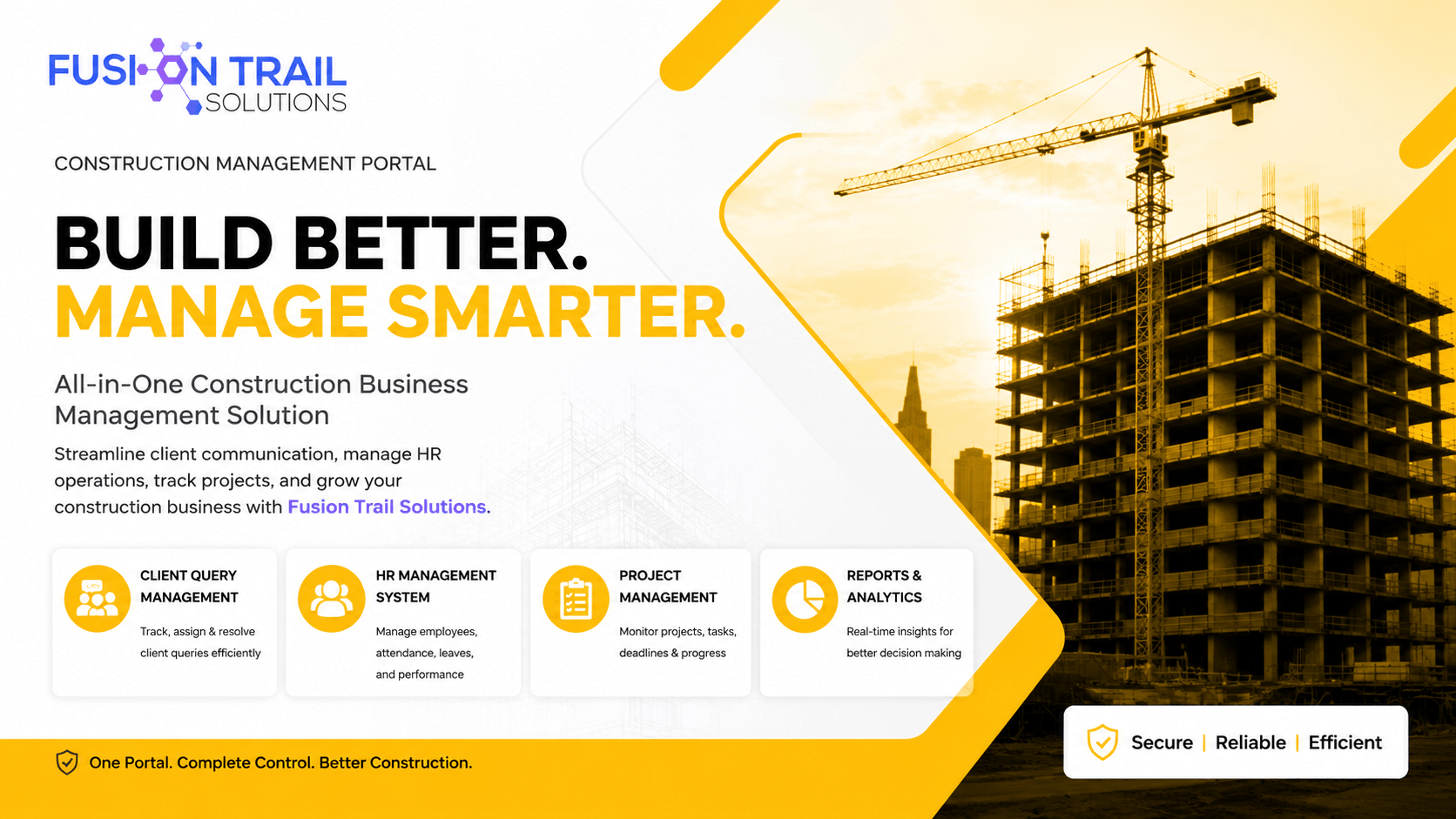
Client query management
Cost estimation
Human resource management
Accounting workflows
Reporting and business visibility
Role-based access control
Organizing these requirements helped establish a clear functional direction for the portal.
It also provided a basis for understanding how different modules should contribute to the overall system instead of operating as unrelated features.
Step 2: Designing a Structured Technical Architecture
A centralized business portal requires more than an attractive interface. Its frontend, backend, database, and APIs must work together consistently.
We used React for the frontend, Node.js and Express.js for backend development, MongoDB for data management, AWS for cloud infrastructure, and REST APIs for communication between application components.
Each technology had a specific role in the overall architecture.
The frontend provided the interface through which users could interact with the system. The backend handled application logic and business operations. MongoDB supported data storage, while REST APIs connected the relevant components.
This separation helped establish a structured foundation for the portal.
Step 3: Developing Integrated Business Modules
Instead of focusing on isolated screens, we organized the development around the business functions the portal needed to support.
Client inquiries, cost estimation, HR management, accounting workflows, and reporting were incorporated into the same management environment.
The purpose was to make the system useful for everyday operations while keeping its functionality organized and accessible.
Step 4: Preparing the System for Production
A working development build is only one part of a successful software delivery.
A production-ready application also needs a considered architecture, dependable data handling, coherent user workflows, and appropriate access controls.
We worked toward delivering a complete operational portal rather than a simple visual prototype, with the objective of providing a practical foundation for business management.
How We Solved the Core Operational Problems
The most valuable part of custom software development is the connection between a business problem and the solution designed to address it.
For this project, we focused on the following improvements.
Centralized Client Query Management
Client inquiries are an important part of construction business operations. When they are difficult to organize, following up and maintaining visibility can become more complicated.
The portal included a client query management feature to bring inquiry-related activities into a structured environment.
This supported a more organized approach to handling client communication and helped address the need for faster response handling.
A Dedicated Cost Estimation Module
We incorporated a cost estimation module to support the construction company's estimation workflow.
Rather than treating estimation as an entirely separate administrative activity, the module became part of the wider management portal.
This approach helped establish a more organized environment for business operations and supported the project's goal of reducing reliance on disconnected manual processes.
Integrated HR Management
The HR management system was designed as another core component of the portal.
Bringing HR activities into the centralized platform helped align this function with the company's broader operational environment.
The objective was to create a more structured management experience instead of requiring every business function to operate independently.
Organized Accounting Workflows
Accounting activities require consistency and careful organization.
The project incorporated accounting workflow automation to support more structured business processes and reduce unnecessary manual coordination.
The emphasis was on improving how operational activities were organized within the portal, rather than claiming specific financial savings that had not been independently measured.
Reporting Dashboard and Role-Based Access
A reporting dashboard provided a dedicated place for business reporting and operational visibility.
Role-based access was also included to support differentiated access to the system according to user responsibilities.
Together, these capabilities helped make the portal more than a collection of individual tools: they contributed to a centralized business management environment.

Technology Stack: Choosing the Right Tools for the Right Responsibilities
The technology stack played an important role in delivering the project.
React
React powered the frontend experience, supporting a component-based approach to building the portal's user interface.
Node.js
Node.js provided the backend runtime for application functionality and server-side operations.
Express.js
Express.js supported the backend API structure and helped organize communication between the frontend and backend.
MongoDB
MongoDB served as the database technology for storing and managing application data.
REST APIs
REST APIs connected the application components and provided a structured communication layer for the portal's business functions.
AWS
AWS provided the cloud infrastructure used as part of the solution's deployment architecture.
The important consideration was not simply selecting popular technologies. It was bringing these components together into an architecture that supported the project's operational requirements.
Quality Was a Development Priority, Not an Afterthought
A business management portal must be designed around more than its initial appearance. Its modules need to work together, its workflows need to make sense, and its technical structure needs to support reliable operation.
Throughout a project of this nature, quality considerations include several areas.
Consistent User Experience
Users should be able to navigate the portal and understand where important business functions are located.
A structured interface helps reduce unnecessary complexity and makes the application easier to work with.
Clear Separation of Responsibilities
Frontend presentation, backend business logic, database operations, and API communication each serve different purposes.
Keeping these responsibilities organized makes the system easier to understand and maintain.
Thoughtful Access Management
Business applications can contain information intended for different users and responsibilities.
Including role-based access in the portal established a foundation for managing access according to user roles.
Maintainability and Future Development
Business needs evolve. A portal should therefore be developed with a structure that can be understood, maintained, and extended as requirements change.
The combination of established development technologies and a modular business-focused architecture supported this objective.
Quality is not a single checkbox at the end of a project. It is a consideration that influences technical decisions, interface design, workflow organization, and the overall delivery process.
Six Months of Structured Development
The project timeline was six months, with the deliverable defined as a production-ready system.
A project involving multiple connected business functions requires attention to both individual modules and the relationships between them.
The challenge is not simply to make every feature work independently. It is to ensure that the overall application provides a coherent experience.
This is why architecture, workflow organization, module integration, and production readiness matter so much in custom software development.
Our focus remained on bringing the required business functions together into a unified portal that could serve as a practical operational tool.

The Business Impact: Moving Toward More Organized Operations
The portal was designed to address operational fragmentation by bringing important activities into one centralized platform.
The documented outcomes included:
Improved operational efficiency
Faster client response handling
Better workflow management
Centralized business operations
These outcomes reflect the project's central objective: creating a more organized way to manage essential business activities.
Rather than relying on separate processes for every function, the company gained a dedicated management environment incorporating client queries, cost estimation, HR, accounting workflows, and reporting.
The project also demonstrates an important principle for businesses considering custom software: the right solution should be designed around actual operational needs, not simply around a long list of features.
Note: Quantified improvements, such as percentage reductions in cost or processing time, are not included because verified figures were not provided in the published project details.
What This Project Demonstrates About Our Approach
At Fusion Trail Solutions, this project reflects the importance of connecting technical implementation with business objectives.
The work involved bringing together several operational requirements, selecting an appropriate technology stack, structuring the application architecture, and delivering a centralized management portal.
It also highlights several principles that guide effective custom software development:
Understand the business first. Technical decisions should follow a clear understanding of the operational problem.
Plan the architecture carefully. The relationship between the frontend, backend, database, and APIs matters as much as the individual technologies.
Build around workflows. Features provide greater value when they support the way a business actually operates.
Consider quality throughout development. Maintainability, usability, and access management should be part of the development approach from the beginning.
Focus on practical outcomes. The purpose of a business application is to help people manage their work more effectively, not merely to introduce new technology.
Why Custom Construction Business Management Software Matters
Construction companies have operational requirements that can differ significantly from those of other businesses.
Client communication, cost estimation, HR, accounting, and reporting all need to be managed in ways that support the company's daily activities.
A custom construction business management portal can bring these functions into a unified environment, reducing the need to coordinate every activity through disconnected workflows.
The right solution depends on the business's size, existing processes, technical requirements, and future goals. For some companies, a ready-made platform may be sufficient. For others, a custom-built solution offers the flexibility to organize operations around their specific requirements.
The most important step is identifying the actual problem before choosing the technology.
Conclusion: Building Software with Purpose
The Construction Business Management Portal project was an exercise in bringing business requirements, software architecture, and practical functionality together.
Over a six-month development timeline, Fusion Trail Solutions worked toward a production-ready platform designed to centralize essential construction business operations.
With React, Node.js, Express.js, MongoDB, AWS, and REST APIs forming the technical foundation, the portal brought together client query management, cost estimation, HR, accounting workflows, reporting, and role-based access.
The broader takeaway is that meaningful software development requires more than writing code. It requires careful planning, an understanding of business challenges, considered technical decisions, and a commitment to building solutions that serve a real purpose.
At Fusion Trail Solutions, our focus is on developing custom software that helps businesses organize their operations, improve their workflows, and establish a stronger foundation for future growth.
Have a business process that needs a smarter digital solution? Explore our work and discover how custom software development can help turn operational challenges into structured, practical solutions.
Explore the project: https://www.fusiontrailsolutions.com/case-studies/construction-business-management-portal
Learn more about Fusion Trail Solutions: https://www.fusiontrailsolutions.com/