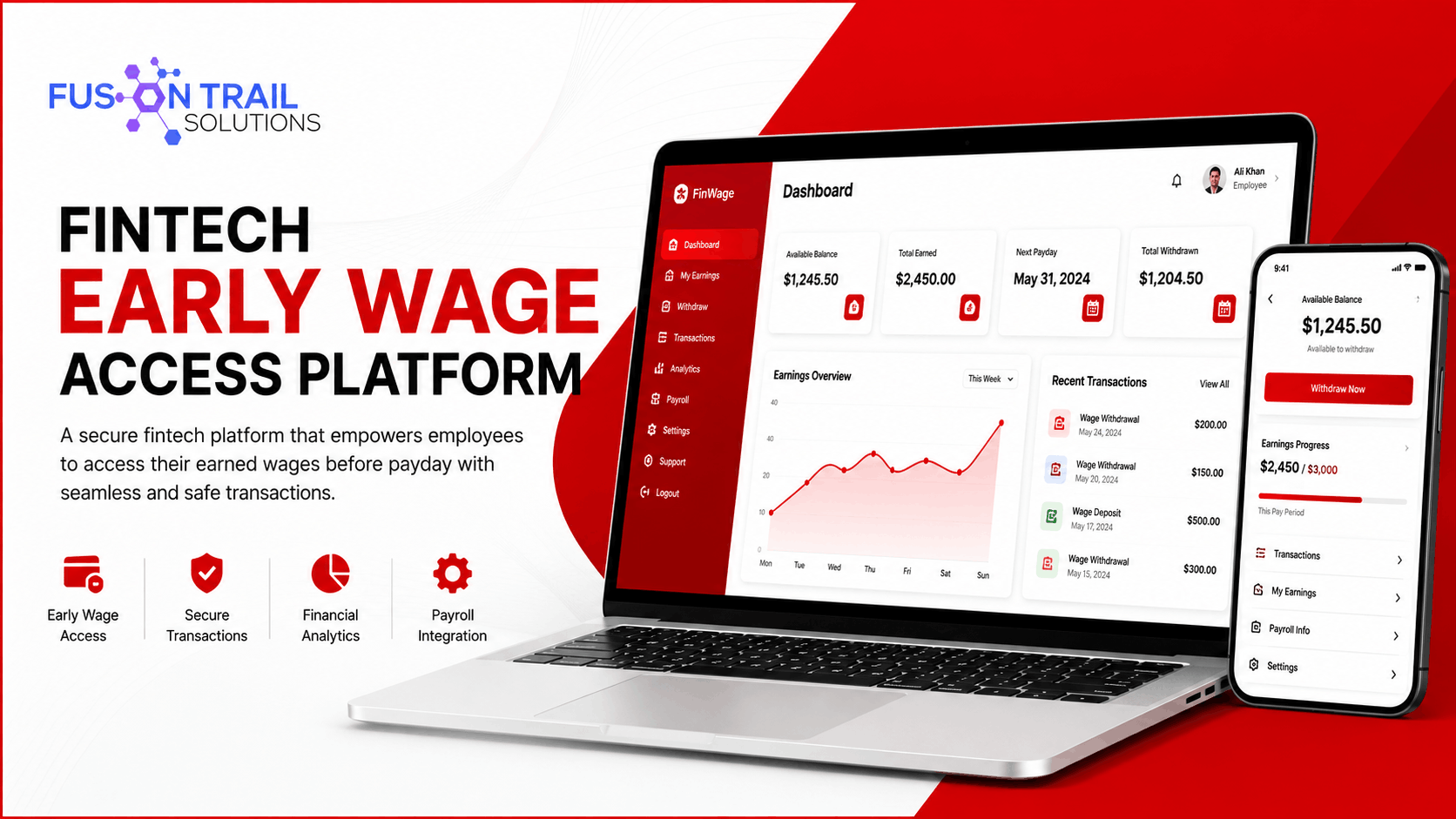
Introduction: Making Earned Wages More Accessible
Financial technology is transforming the way people access, manage, and interact with their money. From digital payments to automated financial services, modern FinTech solutions are helping businesses develop more convenient and efficient financial experiences.
One important development in this space is Early Wage Access (EWA), a financial service that allows eligible employees to access a portion of their already-earned wages before their regular payday, subject to the provider's policies and applicable requirements.
For employees dealing with unexpected expenses or gaps between paydays, waiting for the next scheduled salary payment can create financial pressure. At the same time, businesses need reliable systems to manage payroll information, payment processing, employee accounts, and financial records.
These requirements create an important software development challenge: how can a financial technology platform bring employee wage access, payment automation, and payroll-related operations together in a secure and organized environment?
At Fusion Trail Solutions, we approached this challenge through the development of a custom FinTech Early Wage Access Platform designed to support employee financial accessibility and streamline important financial workflows.
The project required a business-focused development strategy, an appropriate technical architecture, payment system integration, and a structured approach to managing financial information.
Over a seven-month development timeline, our objective was to deliver a production-ready platform that brought together employee wage access, secure transactions, payroll management, financial analytics, payment automation, and administrative controls.
This case study explores the challenges behind the project, the development strategy we followed, the technologies that powered the solution, and the importance of building financial software around security, usability, and operational efficiency.
Understanding the Business Challenges
Successful FinTech development begins with understanding the relationship between financial services, business operations, and user expectations.
An early wage access platform must support employees who need convenient access to earned wages while providing businesses with an organized way to manage payroll-related information and payment workflows.
The challenge is not simply to create an interface where employees can request money. The platform also needs to coordinate financial information, payment processing, administrative responsibilities, and payroll integration.
Our development approach focused on four major challenges.
1. Delayed Access to Earned Wages
Traditional payroll arrangements generally operate according to scheduled payment cycles. Although these arrangements serve important administrative purposes, they may not provide employees with the flexibility they need when unexpected expenses arise before payday.
An early wage access platform offers a different approach by allowing eligible employees to access earned wages earlier, subject to the platform's rules and applicable requirements.
The challenge was to build a dedicated digital environment capable of supporting this service while keeping employee access and financial management within a structured workflow.
Our solution incorporated an employee wage access feature designed around the platform's core purpose: making earned wages more accessible.
2. Manual Payment Processing
Payment-related workflows can involve several connected activities, including processing transactions, updating records, and coordinating financial information.
When these activities rely heavily on manual handling, administrative teams may face unnecessary repetition and processing delays.
Manual processes can also make it more difficult to maintain consistent operational records.
To address this challenge, we incorporated payment automation and payment gateway integration into the platform's architecture.
The objective was to establish more organized payment workflows and reduce unnecessary manual coordination.
3. Limited Financial Visibility
Financial applications need to present information in a way that helps users and administrators understand relevant activities.
Without an organized view of financial information, reviewing transactions, monitoring operational activity, and managing administrative responsibilities can become more complicated.
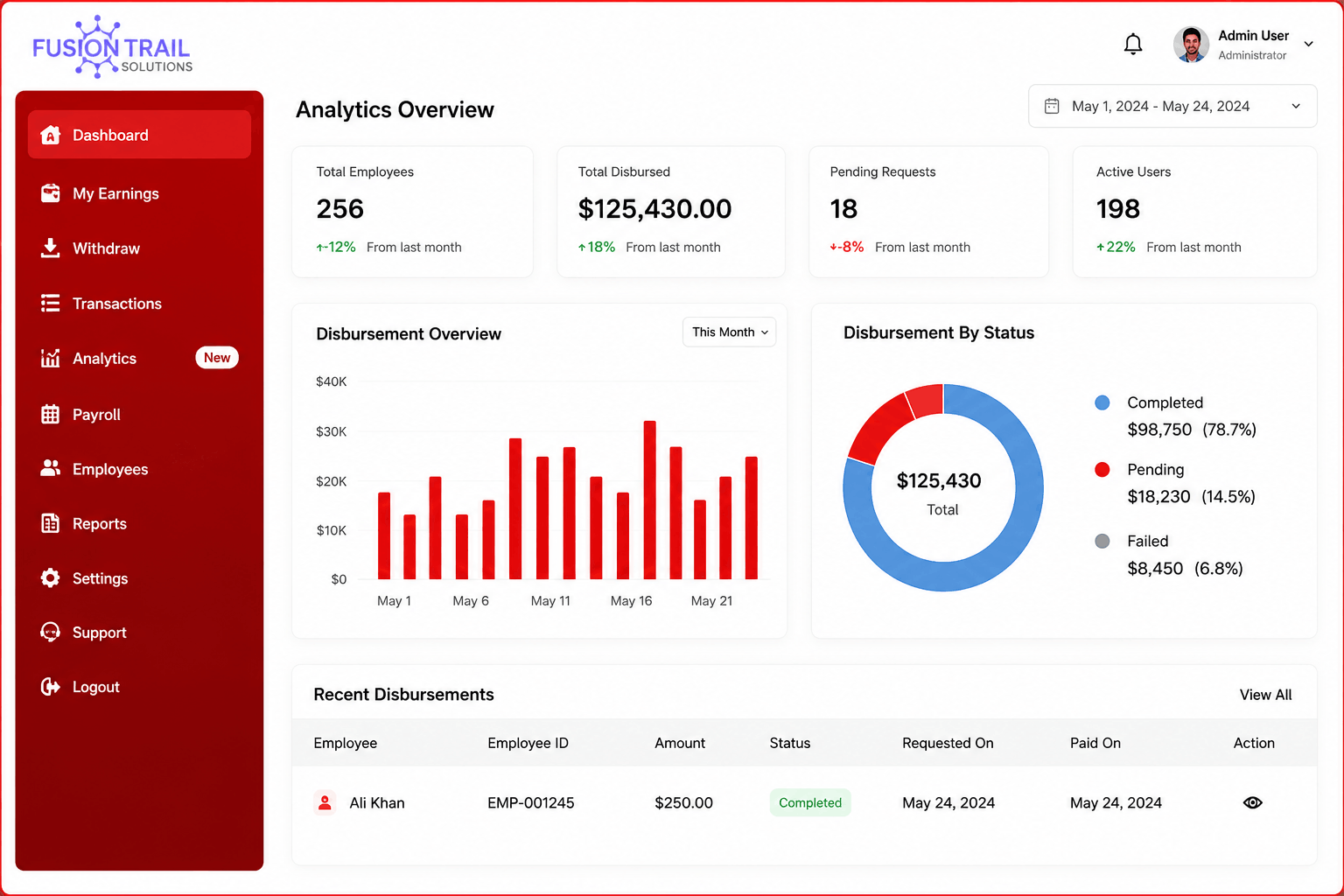
Our solution included financial analytics and an administrative dashboard to support more centralized financial management.
These components were designed to bring important information into a dedicated management environment.
4. Complex Payroll Operations
Payroll-related systems need to handle information carefully because employee earnings, payment records, and payroll calculations are closely connected.
An early wage access service must also account for the relationship between an employee's earned wages and the amount that may be made available before the regular payday.
This makes payroll integration an important part of the overall architecture.
We incorporated a payroll integration system to connect the platform's financial service with payroll-related workflows.
The goal was to support a more coordinated approach to employee wage access and financial administration.
Our Development Strategy: Planning Before Implementation
Building a financial technology platform requires a clear understanding of business requirements before technical implementation begins.
A platform may include many features, but its success depends on how well those features work together to support the intended service.
For this project, our approach focused on requirements organization, application architecture, payment integration, and the development of a centralized user experience.
Step 1: Identifying the Core Requirements
The first priority was to define the major functions the platform needed to support.
These included:
Employee early wage access
Secure transaction processing
Payroll management
Payment automation
Financial analytics
Administrative dashboard functionality
Each requirement contributed to the broader objective of creating an organized early wage access service.
Identifying these functions also helped establish the relationship between the employee-facing experience and the administrative processes needed to support it.
Step 2: Designing the Application Architecture
A FinTech platform requires a clear separation of responsibilities between its user interface, backend services, data storage, and external payment integrations.
We used React for the frontend, Node.js for backend application services, PostgreSQL for relational data management, REST APIs for communication, and AWS as part of the cloud infrastructure.
Docker was also included in the technology stack.
This architecture provided a structured foundation for connecting the employee portal with backend functionality, financial data, and payment-related services.
The objective was to build a coordinated application rather than a collection of independent features.
Step 3: Integrating Payment Workflows
Payment integration was a central part of the project.
An early wage access platform must support payment-related operations within a clear business workflow. This requires attention to transaction handling, the communication between application components, and the management of relevant financial records.
We incorporated payment gateway integration to support the platform's payment processing requirements.
This helped establish a technical foundation for connecting the application's financial functionality with payment services.
Step 4: Connecting Payroll and Employee Management
Employee wage access depends on information about earned wages and the rules governing eligibility.
Payroll integration therefore plays an important role in connecting the service's business logic with the relevant employee and financial information.
The platform included payroll management and integration capabilities to support this relationship.
The objective was to organize employee wage access and payroll-related workflows within the same financial technology environment.
Step 5: Building a Centralized Management Experience
The platform needed to support both employee-facing functionality and administrative responsibilities.
We incorporated an employee portal and an administrative dashboard to provide dedicated interfaces for different operational needs.
This approach helped organize the user experience while keeping employee services and administrative management within the broader application architecture.
How We Addressed the Core Challenges
The value of a custom software solution comes from how effectively it addresses real operational requirements.
For this project, we focused on connecting employee wage access, payment processing, payroll management, and financial visibility through a centralized platform.
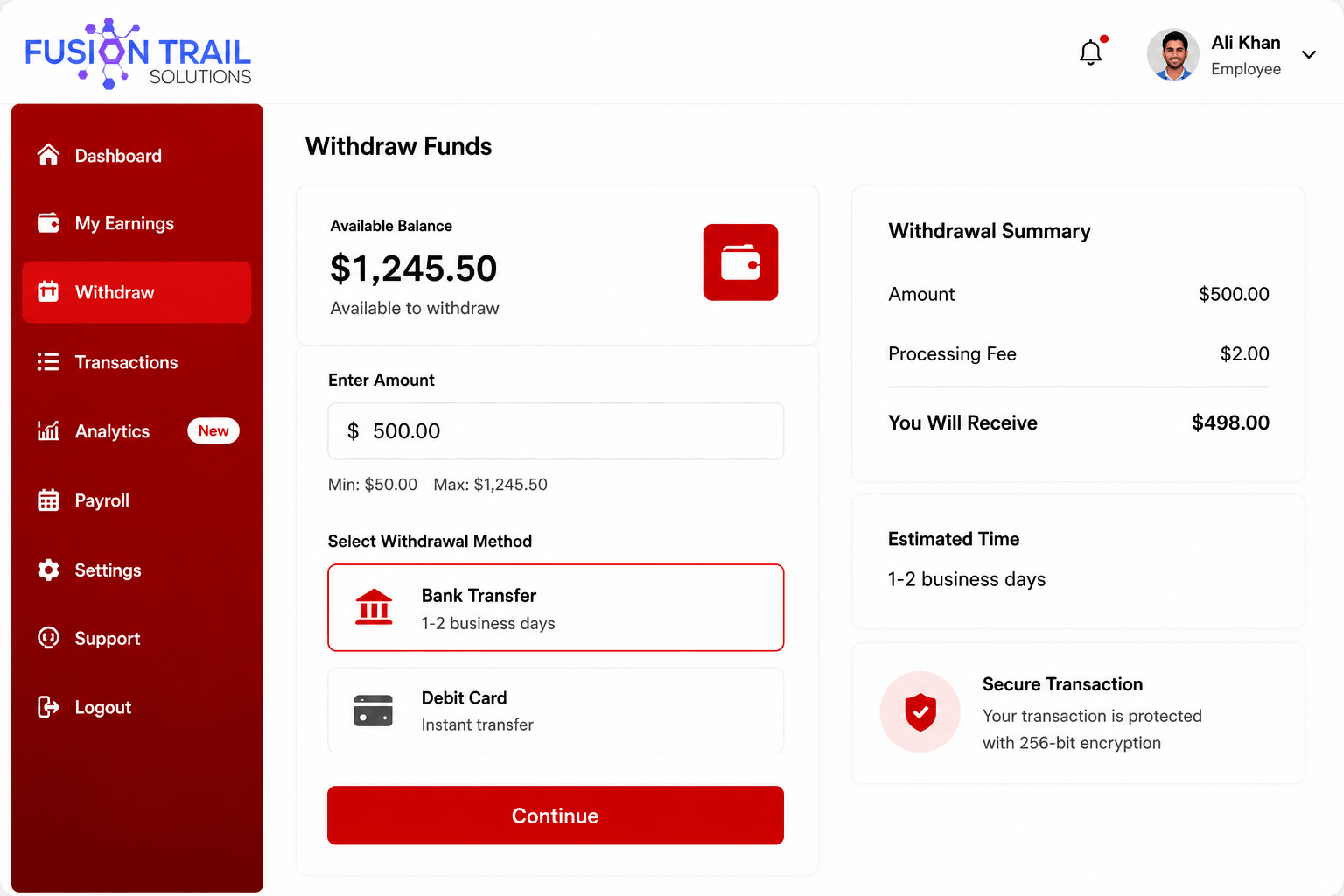
Employee Early Wage Access
Employee wage access was the central feature of the platform.
The service was designed to enable eligible employees to access earned wages before their scheduled payday, according to the applicable platform rules.
This functionality supports the broader objective of improving employee financial accessibility.
The development challenge was to make this service part of an organized digital experience rather than treating it as an isolated transaction feature.
Secure Transaction Management
Financial applications must handle transactions with appropriate attention to data protection, access management, and operational integrity.
A well-designed transaction workflow should account for how payment requests are handled, how transaction information is recorded, and how relevant application components communicate.
The platform incorporated secure transaction functionality as a core requirement.
Its backend APIs and payment integration formed part of the technical foundation for managing financial operations.
Security in financial software is an ongoing responsibility rather than a single feature. Actual security assurance depends on implementation details, testing, operational controls, and applicable compliance requirements.
Payroll Management and Integration
Payroll management was another essential component of the platform.
The relationship between payroll information and early wage access requires a clear approach to managing relevant employee and earnings data.
We incorporated payroll management and integration functionality to support these connected processes.
Bringing payroll-related workflows into the platform helped establish a more coordinated management environment.
Payment Automation
Manual payment processing can introduce unnecessary administrative effort into financial operations.
The platform included payment automation to support a more structured approach to payment-related workflows.
Automation can help reduce repetitive handling when appropriately designed, while clear transaction records and exception-handling procedures remain important for financial accountability.
The goal was to support operational efficiency without losing sight of the care required in financial processing.
Financial Analytics
Financial analytics can help administrators review relevant information and better understand operational activity.
The platform incorporated financial analytics as part of its broader financial management capabilities.
Together with the administrative dashboard, this functionality provided a dedicated environment for accessing and reviewing important information.
Administrative Dashboard
A financial platform needs a management interface that brings important administrative functions together.
The administrative dashboard was included to support centralized platform management.
Its role within the overall solution was to complement the employee portal and help organize administrative activities within the same application.
Technology Stack: The Foundation Behind the Platform
The technologies selected for a FinTech application need to work together reliably and support the platform's functional requirements.
Our technology stack included React, Node.js, PostgreSQL, AWS, Docker, REST APIs, and payment gateway integration.
React: Building the Employee Portal
React was used to develop the frontend.
Its component-based architecture supports the creation of reusable interface elements and helps organize the different parts of a web application.
For an early wage access service, the frontend plays an important role in making financial information and available actions understandable to employees.
Node.js: Backend Application Services
Node.js provided the runtime for backend functionality.
The backend supports application logic, coordinates requests, and connects the frontend with data services and integrated systems.
A structured backend architecture is particularly important for applications that coordinate employee information, payroll workflows, and payment-related operations.
PostgreSQL: Managing Financial Data
PostgreSQL served as the platform's relational database technology.
Financial applications often manage related records, such as employee accounts, payment transactions, and payroll information.
A relational database provides a structured environment for organizing these relationships and maintaining consistency across relevant records.
The specific safeguards required for financial data depend on the application's implementation and operational requirements.
REST APIs: Connecting Application Components
REST APIs provided the communication approach used to connect application components.
A clear API structure helps organize how frontend interfaces communicate with backend services and how different parts of an application exchange information.
For a platform involving employee wage access and payment integration, these interfaces are an important part of the overall architecture.
Payment Gateway Integration: Supporting Digital Transactions
Payment gateway integration formed a core part of the platform's financial functionality.
It connected the application architecture with payment processing capabilities needed to support the intended service.
Payment integration must be designed around the selected provider's requirements, transaction states, error handling, and appropriate financial controls.
AWS: Cloud Infrastructure
AWS formed part of the platform's cloud infrastructure.
Cloud hosting can provide a foundation for running application services and supporting the operational requirements of a web-based financial platform.
The appropriate deployment configuration depends on the application's performance, availability, security, and compliance requirements.
Docker: Application Deployment
Docker was included in the project's technology stack.
Containerization can help package application components into consistent environments, supporting more organized deployment and environment management.
Together, these technologies provided the foundation for the platform's application architecture.
Quality and Security: Essential Considerations in FinTech Development
Quality is especially important when developing software that manages financial information and payment-related workflows.
A visually appealing interface is not enough. The application also needs an organized architecture, clear transaction handling, appropriate access controls, and careful management of financial data.
Several considerations are particularly important for a platform of this type.
Data Protection and Access Management
Financial applications may handle sensitive employee and transaction information.
The system should therefore be designed with appropriate access restrictions, secure communication, and safeguards for sensitive data.
The exact controls depend on the implemented architecture and the security requirements of the platform.
Reliable Transaction Workflows
Payment-related operations need clear transaction states and appropriate handling of unsuccessful or interrupted requests.
These considerations help support consistent financial records and reduce the risk of confusing or incomplete transaction handling.
A production-ready financial platform should account for both successful processing and situations that require additional attention.
Consistent Application Architecture
The frontend, backend, database, and payment integration serve different responsibilities.
Keeping these responsibilities organized can improve maintainability and make the system easier to understand as it evolves.
A structured architecture also provides a foundation for reviewing how data moves through the application.
Responsible Payroll Integration
Payroll information needs to be handled carefully because it directly relates to employee earnings and financial entitlements.
An early wage access platform should clearly define how earned wages are calculated, what portion may be accessed, and how transactions interact with payroll processes.
The implementation must follow the applicable business rules and relevant legal and regulatory requirements.
Production Readiness
Preparing an application for production involves more than implementing its visible features.
It requires attention to deployment configuration, application behavior, data management, integration requirements, and operational responsibilities.
For this project, the intended deliverable was a production-ready platform, supported by the selected application and cloud technologies.
Seven Months of Focused Development
The documented development timeline for the FinTech Early Wage Access Platform was seven months.
A project of this nature involves multiple connected areas, including employee-facing functionality, backend application services, payroll management, payment integration, financial data, and administration.
Each component has its own responsibilities, but the relationships between those components are equally important.
For example, employee wage access must connect with relevant payroll information, while payment-related workflows need to fit within the platform's broader financial management processes.
These relationships make planning and architecture important parts of the development process.
Our focus was on bringing the core requirements together into a unified application rather than treating each feature as an independent deliverable.
Project Outcomes: Improving Employee Financial Accessibility
The platform was designed to address delays in accessing earned wages and the operational complexity associated with manual payment and payroll workflows.
The documented project outcomes included:
Improved employee financial accessibility
Reduced payroll processing delays
Enhanced operational efficiency
Better financial management workflows
These outcomes reflect the project's central objective: creating a more organized digital environment for early wage access and financial administration.
By bringing employee wage access, payment processing, payroll management, financial analytics, and administrative functionality into one platform, the solution addressed several connected business requirements.
The platform also illustrates how custom software can help businesses develop financial services around their specific operational needs.
These results are presented qualitatively because verified numerical performance measurements were not provided in the published case study.
What This Project Demonstrates About Our Development Approach
The FinTech Early Wage Access Platform highlights the importance of connecting business requirements with technical implementation.
Developing a financial application requires careful consideration of how users interact with the service, how financial information is managed, and how different application components work together.
Several principles stand out.
Understand the user and the business.
The platform's features needed to support both employee wage access and the administrative processes behind the service.
Plan the architecture before implementation.
The frontend, backend, database, payment integration, and cloud infrastructure needed to form a coherent application.
Treat financial workflows carefully.
Payment processing and payroll integration require clear business rules and appropriate handling of financial information.
Prioritize usability.
An employee-facing financial service should make its essential functions understandable and accessible to its intended users.
Consider security throughout development.
Financial applications require appropriate technical safeguards, careful data management, and attention to applicable compliance obligations.
Focus on practical business outcomes.
The purpose of a financial technology platform is to support a useful service and improve the way relevant operations are managed.
These principles are valuable for organizations developing early wage access services and other financial technology applications.
Why Early Wage Access Software Matters
Early wage access software represents an important area of financial technology because it offers a different way for eligible employees to access money they have already earned.
For businesses, implementing such a service requires more than providing a payment interface.
The platform may need to coordinate employee information, payroll data, eligibility rules, payment processing, transaction records, and administrative reporting.
A custom-built solution can help bring these functions together in a centralized digital environment.
However, the appropriate design depends on the organization's payroll arrangements, the selected payment provider, the operating model, and the applicable regulatory framework.
Businesses must also consider whether the service introduces fees, how employees are informed about its terms, how personal information is protected, and how the system handles payroll adjustments.
Careful planning helps ensure that technical capabilities align with the actual needs of the business and its employees.
Conclusion: Building Financial Technology Around Real Needs
The FinTech Early Wage Access Platform project focused on developing a centralized digital solution for employee wage access, payment processing, payroll management, and financial administration.
Over a seven-month development timeline, Fusion Trail Solutions worked toward delivering a production-ready platform using React, Node.js, PostgreSQL, AWS, Docker, REST APIs, and payment gateway integration.
The solution brought together employee wage access, secure transactions, payroll management, financial analytics, an administrative dashboard, and payment automation.
More importantly, the project demonstrates the role of thoughtful software architecture in connecting financial services with practical business requirements.
Effective FinTech development involves more than implementing payment functionality. It requires understanding the user experience, organizing financial workflows, integrating relevant systems, and considering security and compliance throughout the application's lifecycle.
At Fusion Trail Solutions, we focus on developing custom software solutions that help businesses address operational challenges through structured planning, modern technology, and business-focused engineering.
Planning a FinTech product or payment automation platform? Explore our work and discover how a carefully designed software solution can help turn complex financial workflows into a more organized digital experience.
Explore the project: https://www.fusiontrailsolutions.com/case-studies/fintech-early-wage-access-platform
Learn more about Fusion Trail Solutions: https://www.fusiontrailsolutions.com/