
Creating a healthy eating routine can feel confusing when you don't know how many calories your body needs, how much protein you should consume, or how to balance carbohydrates and fats. Whether your goal is to lose weight, maintain your current weight, or build muscle, having a structured nutrition plan can make it easier to understand your daily requirements.
A Free Diet Plan Generator can help simplify this process by bringing important nutrition calculations and meal-planning features together in one place.
The Diet Roadmap Planner by Fusion Trail Solutions is designed to help users estimate their daily calorie requirements, calculate macronutrient targets, explore projected weight changes, and view a 30-day meal plan based on their selected goals.
Instead of manually working through multiple nutrition calculators, users can access several planning features through one simple online tool.
Try the Free Diet Roadmap Planner:
https://www.fusiontrailsolutions.com/tools/diet-roadmap
What Is a Diet Plan Generator?
A diet plan generator is an online tool that helps users organize their nutrition goals by estimating daily calorie needs and providing guidance about macronutrients such as protein, carbohydrates, and fats.
Depending on its features, a diet planner may use information such as:
Age
Height
Current body weight
Sex
Physical activity level
Weight management goal
Preferred planning timeline
These details help estimate energy requirements and create a more structured starting point for nutrition planning.
A diet plan generator can be particularly useful for beginners who want to understand calorie intake, establish realistic goals, and organize their daily meals.
However, automated calculations are estimates rather than personalized medical or dietary prescriptions.
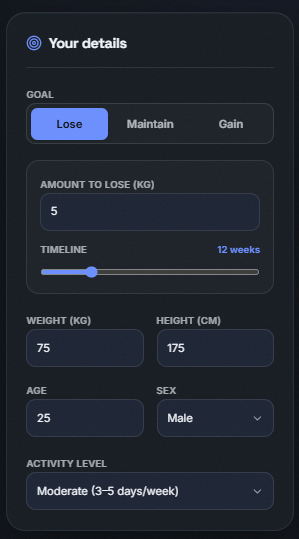
Introducing the Fusion Trail Solutions Diet Roadmap Planner
The Fusion Trail Solutions Diet Roadmap Planner combines several nutrition-planning features into a single browser-based experience.
It is designed for people interested in weight management, calorie tracking, macronutrient calculations, and meal planning.
The tool provides three main goal options:
1. Weight Loss Planning
If your goal is to lose weight, the planner helps estimate a daily calorie target based on your submitted information and selected timeline.
Understanding your estimated calorie requirements can help you organize your eating routine around a planned energy intake.
The tool also provides estimated changes in body weight over your selected planning period.
2. Weight Maintenance Planning
Not everyone wants to lose weight.
Some people simply want to understand how much energy their bodies may require to maintain their current weight.
The maintenance option helps estimate daily calorie requirements using the information entered into the calculator.
This provides a useful starting point for building a consistent eating routine.
3. Weight Gain Planning
People interested in gaining weight or supporting muscle development may need a different nutrition strategy.
The weight gain option helps users explore calorie targets and macronutrient distribution based on their selected goal.
It can provide a starting framework for understanding the relationship between calorie intake, protein, carbohydrates, and dietary fats.
How Does the Diet Roadmap Planner Work?
Using an online diet planner does not have to be complicated.
The Fusion Trail Solutions tool follows a straightforward process.
Step 1: Select Your Fitness Goal
Start by choosing what you want to achieve:
Lose weight
Maintain weight
Gain weight
For weight-loss planning, enter the amount of weight you want to lose.
Step 2: Enter Your Personal Information
Provide the required information:
Current weight in kilograms
Height in centimeters
Age
Sex
Activity level
These details help the calculator estimate your energy requirements.
Make sure your information is accurate because incorrect inputs can produce misleading estimates.
Step 3: Choose Your Planning Timeline
Select the period over which you want to explore your goal.
The planner allows you to adjust its timeline and view estimated weight changes over time.
Remember that actual results can differ because of changes in activity, metabolism, water balance, health conditions, and other individual factors.
Step 4: Calculate Your Daily Calories
After entering your information, the tool displays several important calorie estimates.
These include:
Daily calorie target
Maintenance calories (TDEE)
Resting metabolic rate (BMR)
Understanding these values helps you see how estimated energy requirements relate to your selected goal.
Step 5: Review Your Macronutrient Targets
The calculator also provides estimated daily targets for three major macronutrients:
Protein: An important nutrient involved in muscle maintenance, recovery, and many essential body functions.
Carbohydrates: A major source of energy that supports everyday activities and physical performance.
Fats: An essential macronutrient involved in hormone production, nutrient absorption, and normal body functions.
The tool displays suggested protein, carbohydrate, and fat targets in grams and as percentages of estimated calorie intake.
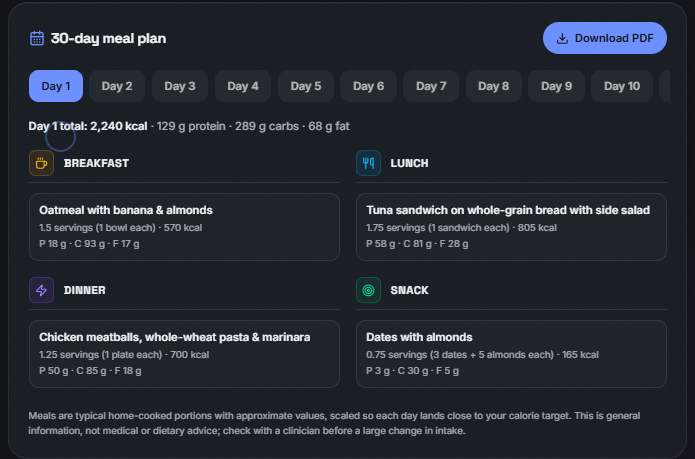
Step 6: Explore Your 30-Day Meal Plan
One useful feature is the 30-day meal plan.
Users can explore daily meal suggestions organized into:
Breakfast
Lunch
Dinner
Snacks
The planner also displays estimated calories and macronutrients for individual meals.
This makes it easier to understand how daily food choices can contribute to an overall nutrition target.
Meal suggestions and nutritional values are approximate and should be checked against actual ingredients, serving sizes, and individual dietary requirements.
Step 7: Download Your Plan
Once you have reviewed the available information, you can use the PDF download option to save your meal plan for future reference.
Having a saved plan can make it easier to review meal suggestions and maintain an organized routine.
Understanding BMR, TDEE, and Daily Calorie Requirements
To understand how a diet calculator works, it helps to know the difference between BMR and TDEE.
What Is BMR?
BMR stands for Basal Metabolic Rate.
It refers to the estimated energy your body uses to maintain essential functions while at complete rest.
These functions include:
Breathing
Circulation
Maintaining body temperature
Supporting essential organ functions
The Fusion Trail Solutions Diet Roadmap Planner uses the Mifflin-St Jeor equation to estimate metabolic requirements.
The original research behind this equation was published in the American Journal of Clinical Nutrition in 1990.
What Is TDEE?
TDEE stands for Total Daily Energy Expenditure.
It represents your estimated total daily energy use, including resting energy requirements and physical activity.
Your activity level plays an important role in this estimate.
For example, someone with a physically demanding routine may require more daily energy than someone who spends most of the day sitting.
TDEE is commonly used as a starting point when estimating calorie targets for weight management.
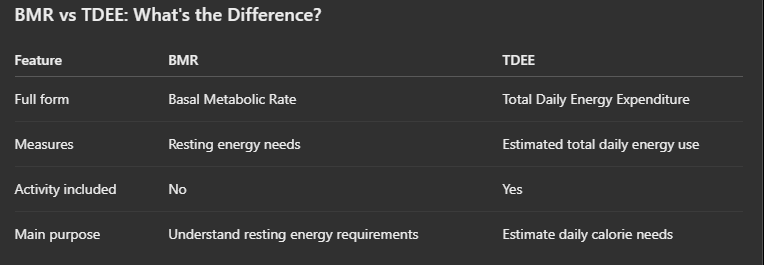
Both measurements provide useful information, but neither should be treated as a perfect measurement of an individual's actual energy expenditure.
What Is a Macro Calculator and Why Does It Matter?
A macro calculator helps estimate how your daily calorie intake can be distributed between protein, carbohydrates, and fats.
These nutrients provide energy and perform different functions in the body.
Protein
Protein provides approximately 4 calories per gram.
It contributes to:
Muscle maintenance
Tissue repair
Normal growth and development
Essential body functions
Carbohydrates
Carbohydrates provide approximately 4 calories per gram.
They are an important energy source, particularly during physical activity.
Common sources include whole grains, fruits, vegetables, rice, and other carbohydrate-containing foods.
Dietary Fats
Fat provides approximately 9 calories per gram.
Dietary fats support several important functions, including the absorption of fat-soluble vitamins and normal hormone production.
Common sources include nuts, seeds, olive oil, and other fat-containing foods.
Understanding Your Daily Macro Targets
A macro calculator converts an estimated daily calorie target into suggested gram amounts.
For example, a hypothetical 2,000-calorie nutrition plan with a 30% protein, 40% carbohydrate, and 30% fat distribution would provide:
NutrientCalorie shareApproximate amountProtein30%150 gCarbohydrates40%200 gFat30%66.7 g
These figures are an educational example, not a universal recommendation.
Actual nutritional needs depend on individual circumstances, health, activity, and dietary requirements.
How to Create a More Structured Weight Loss Roadmap
Weight management is not simply about choosing a calorie number.
It also involves building sustainable habits that support your overall health.
Here are several useful considerations when creating a nutrition roadmap.
Understand Your Starting Point
Begin by understanding your current body weight, estimated energy requirements, activity level, and personal goals.
This gives you a baseline for planning.
Choose a Realistic Timeline
Avoid treating weight management as a race.
Gradual, sustainable changes are generally more appropriate than extreme approaches.
The CDC explains that people who lose weight gradually, at around 1–2 pounds per week, are more likely to maintain their weight loss than people who lose weight faster.
Read more: https://www.cdc.gov/healthy-weight-growth/losing-weight/index.html
This is general guidance, not a suitable target for every individual.
Build Balanced Meals
Try to include a variety of nutritious foods in your eating routine.
Depending on your preferences and needs, this may include:
Vegetables and fruits
Whole grains
Protein-rich foods
Healthy sources of dietary fats
Adequate fluids
A balanced approach is generally more sustainable than eliminating entire food groups without a medical reason.
Consider Your Physical Activity
Daily energy requirements are influenced by movement and exercise.
Walking, strength training, recreational sports, and other physical activities can contribute to an active lifestyle.
Choose activities that are appropriate for your abilities and health.
Review and Adjust Your Plan
Your needs may change over time.
Revisit your goals and eating routine periodically rather than assuming your initial calorie estimate will remain accurate forever.
Who Can Benefit from an Online Diet Planner?
A diet planner can be useful for several types of users.
Beginners: People who want to understand calories, macros, and basic nutrition planning.
Fitness Enthusiasts: Individuals interested in organizing their nutrition around exercise and fitness goals.
Weight Management Beginners: People looking for a structured starting point for understanding their estimated calorie requirements.
Busy Professionals: Individuals who prefer having meal suggestions and nutrition information organized in one place.
Students and Researchers: People interested in learning about BMR, TDEE, calorie requirements, and macronutrient distribution.
The tool is intended for general educational planning among healthy adults, not clinical nutrition management.
Why Use a Free Online Diet Plan Generator?
There are several reasons why online nutrition calculators can be useful.
1. Multiple Calculations in One Place
Instead of visiting separate calculators for every measurement, users can explore calorie estimates, macro targets, and weight projections through one tool.
2. Simple and Accessible
A browser-based tool can be accessed without installing additional software.
3. No Registration Required
The Fusion Trail Solutions Diet Roadmap Planner is free to access and does not require users to create an account.
4. Privacy-Focused Experience
According to the tool's description, calculations run locally in your browser, and entered information is not uploaded or stored by the tool.
5. Meal Planning Support
The 30-day meal plan provides an additional starting point for organizing daily food choices.
6. PDF Download
Users can save the available meal plan as a PDF for convenient reference.
Diet Plan Generator vs Manual Diet Planning
Both approaches can help organize nutrition goals, but they offer different experiences.
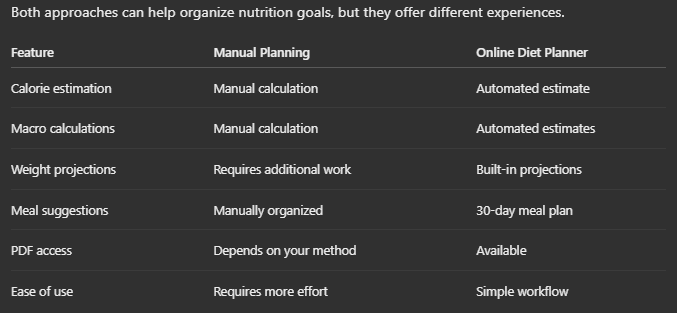
An online calculator can save time, but it does not replace professional dietary assessment or individual judgment.
Frequently Asked Questions
1. Is the Fusion Trail Solutions Diet Planner free?
Yes. The Diet Roadmap Planner is free to use and does not require registration.
2. How does an online diet plan generator work?
It uses information such as age, height, weight, sex, and activity level to estimate energy requirements and provide nutrition-planning information.
3. Can I calculate my daily calorie requirements online?
Yes. An online calorie calculator can estimate daily energy requirements based on your personal information and activity level.
4. What is the difference between BMR and TDEE?
BMR estimates energy used at rest, whereas TDEE estimates total daily energy expenditure, including physical activity.
5. Can I calculate protein, carbohydrates, and fats?
Yes. A macro calculator can estimate the daily gram amounts of these nutrients based on a selected calorie target and macro distribution.
6. Can this planner help with weight loss?
It can help you explore estimated calorie targets, macro distribution, and projected weight changes. Actual results vary, and the tool does not guarantee weight loss.
7. Does the Diet Roadmap Planner support weight gain?
Yes. It includes weight gain as one of its three planning goals.
8. Does it provide a meal plan?
Yes. The tool includes a 30-day meal plan with breakfast, lunch, dinner, snacks, and estimated nutritional values.
9. Can I download my meal plan?
Yes. A PDF download option is available within the planner.
10. Is an online diet calculator accurate?
Online calculators provide estimates using mathematical formulas. Actual energy requirements can differ between individuals, so results should be treated as starting estimates rather than exact measurements.
11. Is this tool suitable for everyone?
It is intended for general educational planning among healthy adults. Children, pregnant or breastfeeding individuals, people with eating disorder histories, and those with medical conditions or specialized nutritional needs should seek qualified professional guidance before making dietary changes.
Start Building Your Diet Roadmap Today
Understanding your calorie requirements and macronutrient targets can make nutrition planning easier and more organized.
Whether you are exploring weight loss, maintaining your current weight, or planning for weight gain, having a clear starting point can help you make more informed decisions about your eating routine.
The Fusion Trail Solutions Diet Roadmap Planner brings calorie estimation, BMR and TDEE calculations, macro targets, weight projections, and a 30-day meal plan together in one accessible online tool.
Ready to explore your nutrition targets?
Use the free Diet Roadmap Planner today:
https://www.fusiontrailsolutions.com/tools/diet-roadmap
Health Disclaimer: This tool and article provide general educational information, not medical advice, diagnosis, or treatment. Calorie and macro calculations are estimates and may not reflect individual needs. Consult a registered dietitian or qualified healthcare professional before making significant dietary changes, especially if you have an existing health condition or specific nutritional requirements.