
Artificial intelligence is moving beyond simple chatbots. Modern AI models are increasingly being designed to reason, write code, use tools, browse information and work as intelligent agents. One model family receiving significant attention in this space is GLM, developed by Z.ai.
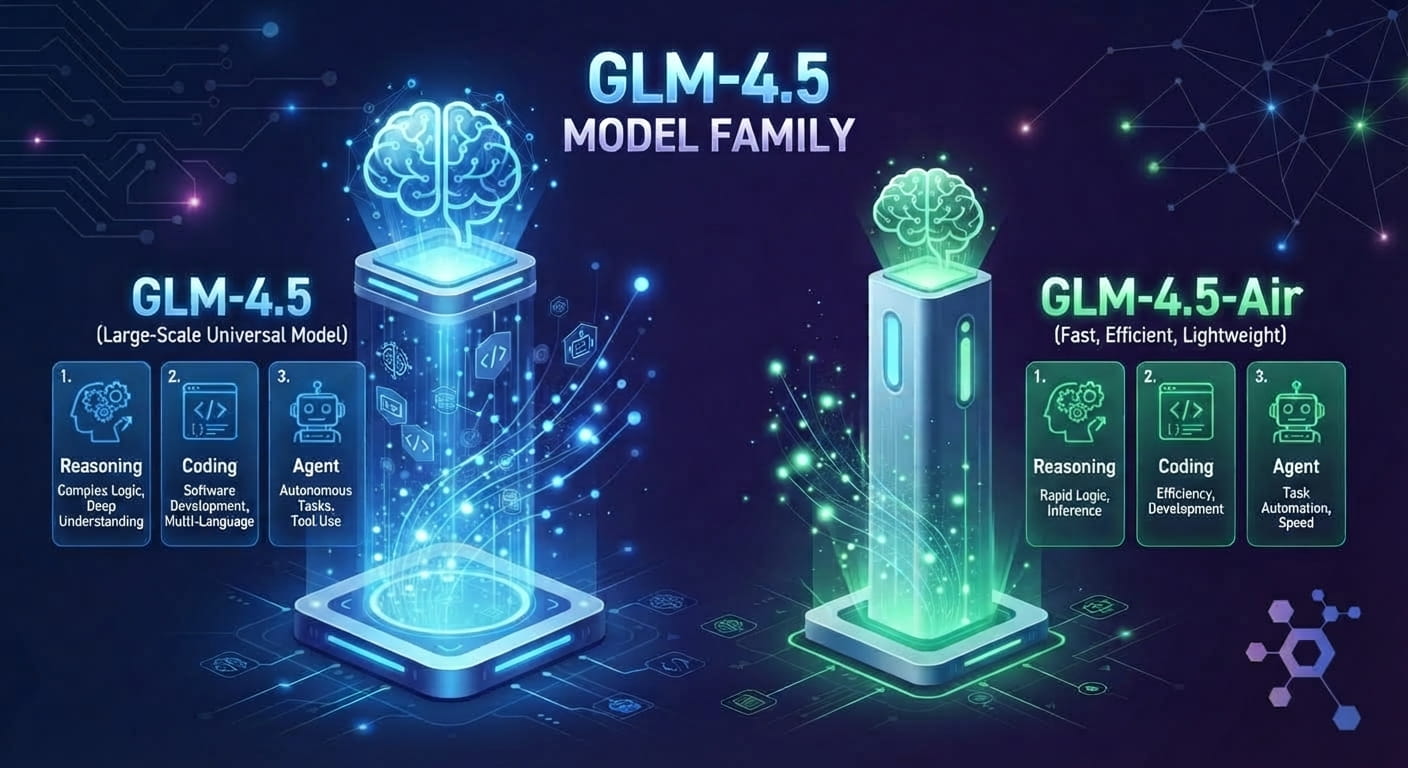
The GLM family has evolved into models designed for general reasoning as well as coding and agentic workflows. Among its major releases, GLM-4.5 and GLM-4.5-Air were introduced as hybrid reasoning models that support both a thinking mode for complex tasks and a non-thinking mode for faster responses.
For developers, students, researchers and AI enthusiasts, GLM is particularly interesting because it brings together several capabilities that are normally associated with separate AI systems.
What Is GLM AI?
GLM stands for General Language Model and refers to a family of large language models developed by Z.ai.
The newer GLM models are designed to handle tasks such as:
Natural-language conversations
Complex reasoning
Programming and debugging
Software development
AI agent workflows
Tool calling
Data analysis
Content generation
Web-based research
Creating applications and digital artifacts
GLM-4.5 was specifically developed with a focus on agentic applications, reasoning and coding. Z.ai reports that the model supports a 128K context length and native function calling.
What Is GLM-4.5?
GLM-4.5 is one of the flagship models in the GLM family.
According to Z.ai, GLM-4.5 contains 355 billion total parameters with 32 billion active parameters, while GLM-4.5-Air contains 106 billion total parameters with 12 billion active parameters. Both use a mixture-of-experts architecture and are designed to combine reasoning, coding and agentic capabilities.
The important thing about GLM-4.5 isn't simply its parameter count. Its design aims to make one model useful across different workflows instead of focusing exclusively on one type of task.
GLM-4.5 can be useful for:
Coding:
Developers can use GLM-4.5 for generating code, understanding existing projects, debugging and building applications.
Reasoning:
The hybrid architecture provides a thinking mode intended for more complex reasoning tasks.
AI agents:
GLM-4.5 was built with agentic applications in mind, including tool use and function calling.
Full-stack development:
Z.ai demonstrates GLM-4.5 being used for frontend and backend development, including creating complete web applications.
GLM-4.5 vs GLM-4.5-Air
One of the interesting parts of the GLM family is the availability of different model sizes.
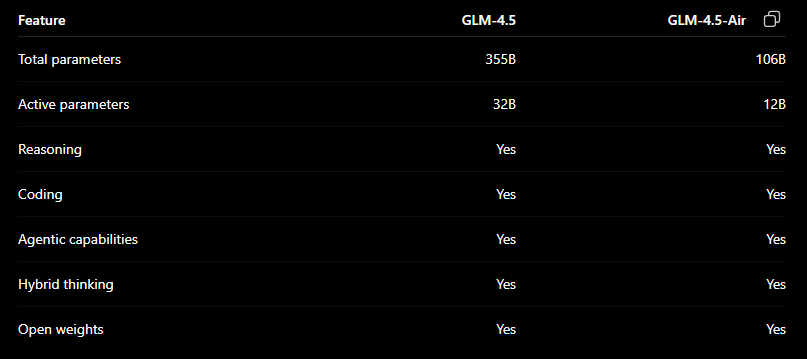
The smaller GLM-4.5-Air is designed to provide a more compact alternative while retaining the core reasoning, coding and agentic capabilities of the GLM-4.5 family.
Is GLM-4.5 Open Source?
GLM-4.5 and GLM-4.5-Air have publicly available model weights, including base, hybrid reasoning and FP8 variants. The Hugging Face model documentation states that these releases use the MIT open-source license, allowing commercial use and secondary development subject to the license terms.
This makes GLM particularly relevant to developers who want to experiment with AI models outside traditional closed API-only platforms.
Developers can access the models through platforms such as Hugging Face and ModelScope, while local deployment is supported through frameworks including vLLM and SGLang.
GLM-4.5 for Coding
One of the strongest areas associated with GLM-4.5 is software development.
Modern AI coding isn't limited to generating a small Python function. Developers increasingly expect AI systems to understand repositories, modify multiple files, run tools and complete multi-step development tasks.
GLM-4.5 was evaluated on coding benchmarks including SWE-bench Verified and SWE-Terminal-Bench. In Z.ai's reported evaluation setup, GLM-4.5 achieved 64.2% on SWE-bench Verified.
It can be used for workflows such as:
Generating HTML, CSS and JavaScript
Building React applications
Creating backend APIs
Debugging code
Refactoring projects
Understanding large codebases
Creating database-related code
Building full-stack applications
Working with coding-agent frameworks
Z.ai also describes integrations with coding tools such as Claude Code, Roo Code and CodeGeeX.

GLM AI for AI Agents
AI agents are becoming one of the biggest areas in artificial intelligence.
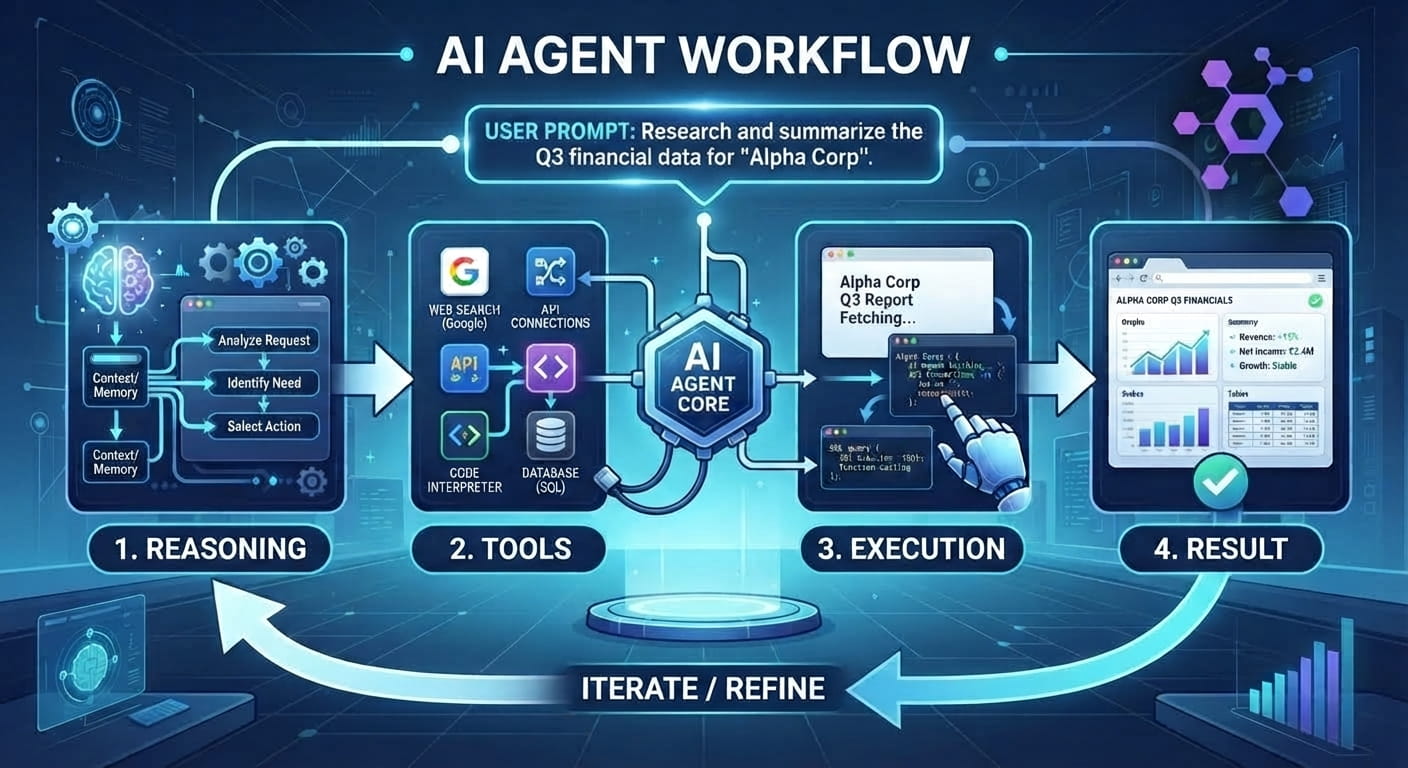
Instead of simply answering a question, an AI agent can potentially:
Understand a goal
Break the goal into tasks
Use external tools
Execute actions
Analyze the results
Continue working until the task is completed
GLM-4.5 was designed specifically with these types of workflows in mind.
Z.ai reports native function calling and evaluates GLM-4.5 on agentic benchmarks including TAU-bench, BFCL and BrowseComp.
This makes GLM interesting for developers building:
Coding agents
Research agents
Customer-support agents
Automation systems
Developer assistants
AI productivity tools
Multi-step business workflows
GLM-4.5 vs ChatGPT, Claude and DeepSeek
Search interest around AI models often comes from comparisons.
However, there isn't one universal model that is best for every task. Different models can perform differently depending on the benchmark, prompting method, tools, context and specific workload.
Z.ai's own GLM-4.5 evaluation compared it with models from OpenAI, Anthropic, Google DeepMind, xAI, Alibaba, Moonshot and DeepSeek across agentic, reasoning and coding benchmarks.
That means comparisons such as:
GLM-4.5 vs ChatGPT
GLM-4.5 vs Claude
GLM-4.5 vs DeepSeek
GLM-4.5 vs Gemini
can be useful search topics, but the results should always be interpreted according to the particular task and benchmark rather than treating one benchmark as a universal measure of AI quality.
How to Use GLM AI
There are several ways developers can experiment with GLM models.
1. Z.ai
Users can interact with GLM-4.5 through the Z.ai platform.
2. GLM API
Developers can access GLM models through Z.ai's API platform, which provides an OpenAI-compatible interface for GLM-4.5 and GLM-4.5-Air.
3. Hugging Face
Developers interested in model experimentation can access the publicly released GLM models through Hugging Face.
4. Local Deployment
For developers with suitable hardware, GLM models can be deployed using inference frameworks such as vLLM and SGLang.
Why Developers Are Interested in GLM AI
The biggest attraction of GLM isn't just that it is another chatbot.
Its broader goal is to combine:
Reasoning + Coding + Tool Use + Agents
into one AI system.
That combination can be useful for developers building the next generation of AI-powered software.
For example, imagine asking an AI:
"Build a complete task-management website with authentication, a dashboard, database integration and responsive UI."
Instead of only generating a few code snippets, an agent-oriented model can potentially work through the project as a sequence of development tasks.
This is the direction in which AI-assisted software development is moving.
What Makes GLM Different?
GLM's approach focuses heavily on combining multiple capabilities.
GLM-4.5 uses a Mixture-of-Experts (MoE) architecture and a hybrid reasoning approach. Its training process also included large-scale general, code and reasoning data, followed by additional post-training and reinforcement-learning stages.
The model is therefore positioned not simply as a conversational AI, but as a foundation for more complex AI-agent applications.
The Future of GLM AI
The AI industry is moving toward models that can do more than generate text.
The next generation of AI systems is increasingly focused on:
Autonomous task execution
AI coding agents
Software development
Tool calling
Web research
Multistep reasoning
AI-powered productivity
Local and open-weight models
Agentic applications
GLM's focus on reasoning, coding and agents puts it directly within this broader shift.
For developers, this means GLM can be an interesting model family to watch as AI moves from chat-based assistance toward action-oriented software development.
Final Thoughts
GLM has become an important name in the rapidly evolving AI model landscape.
With GLM-4.5 and GLM-4.5-Air, Z.ai is targeting a combination of reasoning, coding and agentic capabilities rather than focusing on conversation alone. The models are available with publicly released weights, and developers can explore them through Z.ai, APIs and open-model ecosystems.
For developers, AI researchers and technology enthusiasts, GLM is worth watching because the future of AI may depend less on simply answering questions and more on understanding goals, writing software, using tools and completing real-world tasks.