Artificial intelligence is changing how developers write code, content creators produce articles, businesses analyze information, and students learn new skills. But with so many AI models competing for attention, choosing the right one is becoming increasingly difficult.
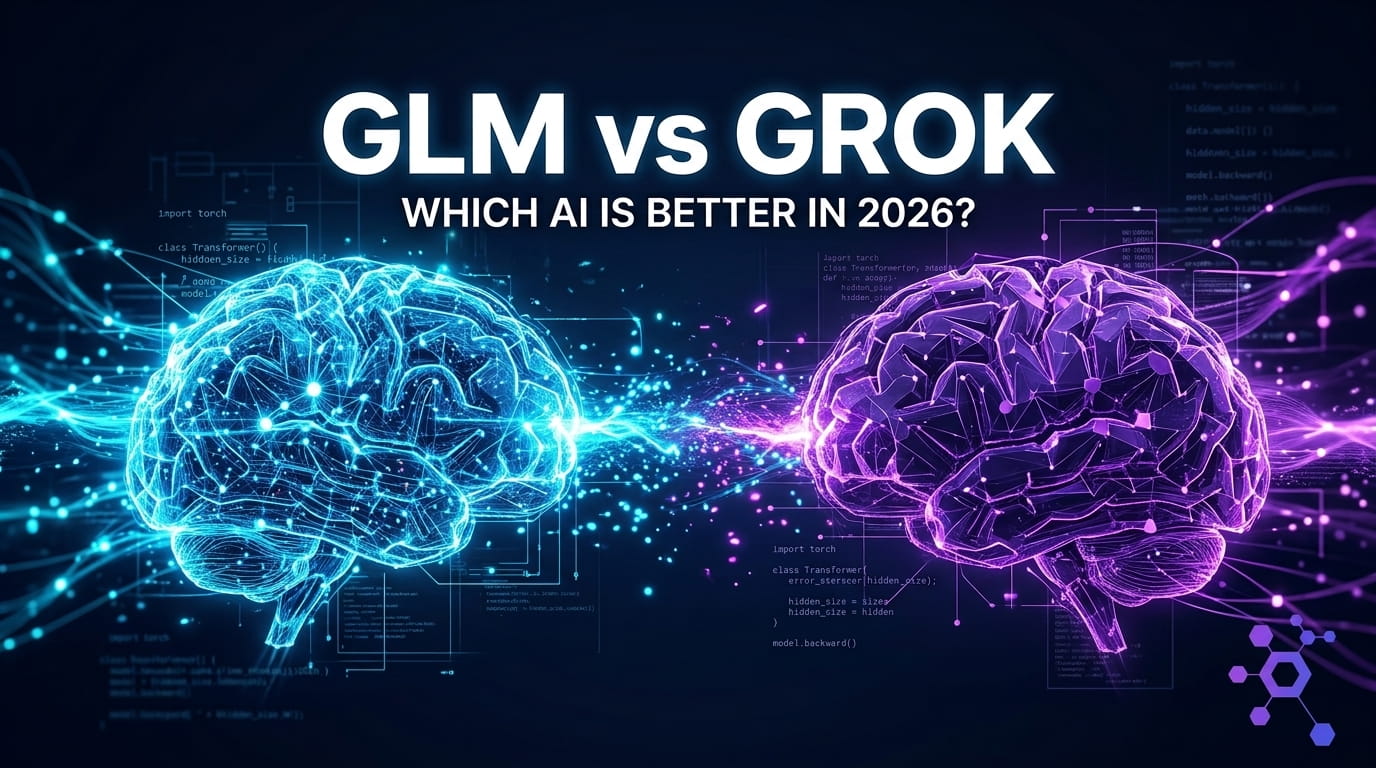
Two names worth comparing in 2026 are GLM by Z.ai and Grok by xAI. Both have developed beyond simple chatbot experiences, offering capabilities for coding, reasoning, research, and more complex workflows. However, they have different model families, product ecosystems, and strengths.
GLM's latest GLM-5.3 release emphasizes complex coding and long-horizon tasks, while xAI's Grok 4.7 focuses on coding, knowledge work, and extended problem-solving. These are the companies' stated priorities, not proof that one model wins every task.
So, which is better: GLM or Grok?
In this detailed comparison, we will examine their capabilities, coding performance, writing quality, research potential, creative tools, practical limitations, and value for different users. By the end, you will have a clearer idea of which AI deserves a place in your daily workflow.
What Is GLM AI?
GLM is a family of AI models developed by Z.ai, a company known for building language models with reasoning, coding, and agentic capabilities.
GLM is designed to support tasks ranging from answering questions and generating text to solving programming problems and working through complex, multi-step instructions.
The GLM family includes models developed for different levels of capability and deployment needs. Its newer generations have increasingly focused on coding agents, tool use, and longer-running tasks.
GLM-5.3, announced in August 2026, builds on the GLM-5.2 foundation and emphasizes improvements in complex coding and long-horizon task performance. Z.ai reports a 50% improvement over GLM-5.2 on its own Code Bench. This is a vendor-reported benchmark result, not a guarantee of a 50% improvement in every real-world task.
What Can GLM Do?
Generate, explain, and debug code.
Help plan and structure software projects.
Draft blog posts, documentation, and other written content.
Work through logical and multi-step reasoning problems.
Assist with workflows that involve tools and repeated actions.
Support developers through compatible coding environments and APIs.
Who should consider GLM?
GLM is worth evaluating if you are a software developer, technical writer, student, or AI enthusiast looking for a model that can assist with complex instructions and programming workflows.
What Is Grok AI?
Grok is an AI system developed by xAI. It is available through Grok's own products and has integrations across selected development and productivity platforms.
One of Grok's distinguishing characteristics is its connection to the X ecosystem, which can be useful for exploring public conversations and discovering current discussions when the relevant search features are available.
However, Grok is not limited to social media questions. Its newer models also target software development, reasoning, knowledge work, and agentic tasks.
Grok 4.7, announced in September 2026, is positioned by xAI as its most capable model for coding and knowledge work. The company highlights longer-running tasks, improved self-verification, and stronger management of extended context.
Grok's wider product ecosystem also includes creative capabilities. Its Imagine products support image and video generation, with the available features depending on the product, plan, and access method.
What Can Grok Do?
Generate, explain, and troubleshoot code.
Help research topics and explore current discussions.
Draft articles, social media posts, and marketing copy.
Assist with reasoning and knowledge-intensive tasks.
Generate or edit creative media through supported Imagine features.
Support development workflows through compatible tools and integrations.
Who should consider Grok?
Grok is worth exploring if you want an AI assistant for research, coding, creative work, and information discovery, particularly when its X-related features are useful to your workflow.
GLM vs Grok for Coding: Which Is Better?
For developers, coding is one of the most important areas in this comparison.
A useful coding assistant must do more than generate a working-looking code snippet. It should understand existing code, identify bugs, follow project requirements, handle edge cases, and help test changes without breaking unrelated functionality.
GLM for Software Development
GLM-5.3 is specifically positioned around complex coding and longer-running tasks. This makes GLM worth testing for:
Building front-end components and page layouts.
Generating backend routes and API logic.
Explaining unfamiliar codebases.
Debugging errors and suggesting fixes.
Refactoring existing code.
Assisting with multi-step programming tasks.
For example, you could ask GLM to inspect a React component, identify why a form is not accepting input, and suggest a focused correction.
For larger projects, the quality of your instructions matters. Give the model the relevant files, explain the expected behavior, and ask it to preserve existing features unless a change is explicitly required.
Grok for Software Development
Grok 4.7 is also designed for demanding coding and knowledge-work tasks. xAI highlights longer-running problem-solving, self-verification, and coding performance.
Grok is worth testing for:
Generating application components.
Debugging errors and reviewing code.
Planning software architecture.
Working through multi-step engineering tasks.
Exploring technical questions.
Using supported coding integrations.
For example, you could ask Grok to review an API implementation, identify potential failure points, and propose tests before making changes.
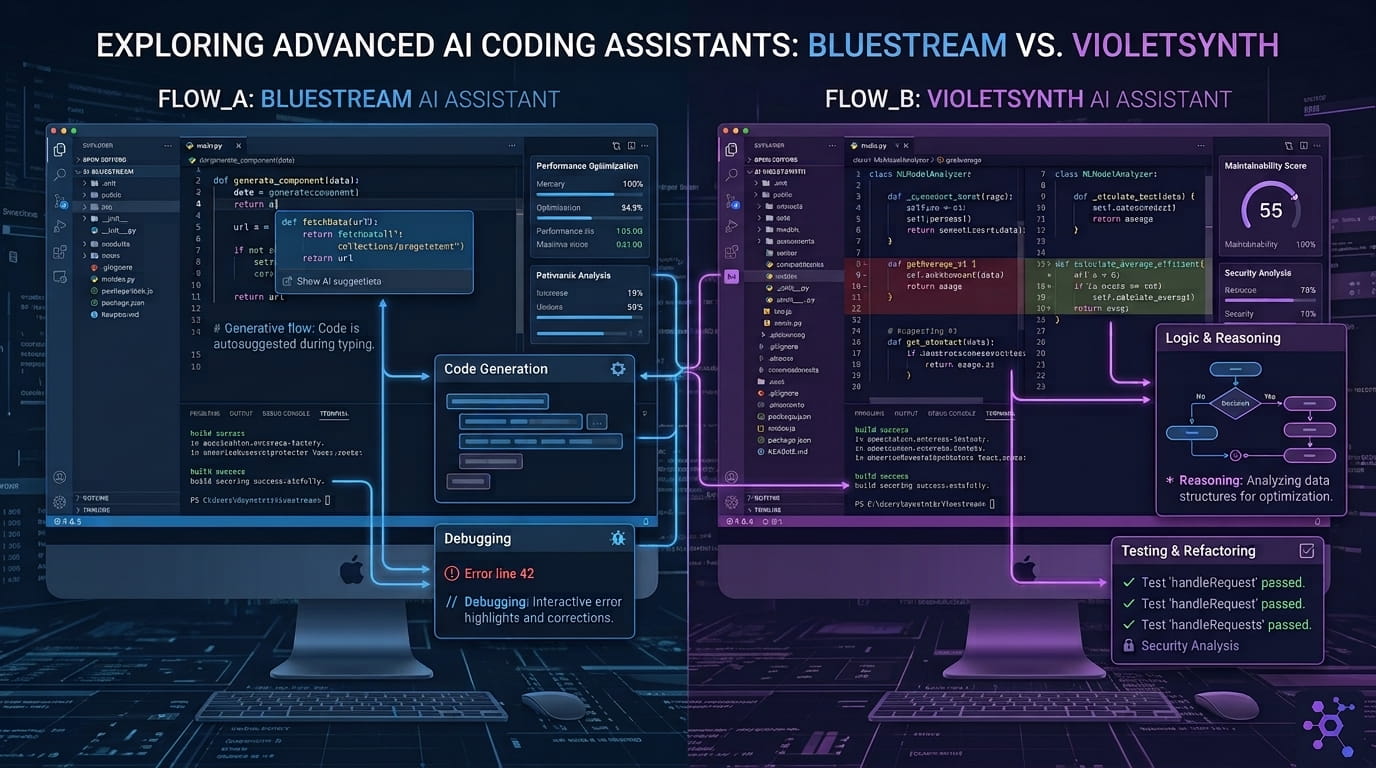
Which Wins at Coding?
There is no reliable universal winner based on product descriptions alone. Both deserve testing against the same real development tasks.
A fair test should include a bug fix, a multi-file feature, a unit-test task, and a code review. Run each task with the same requirements and evaluate correctness, test results, maintainability, and the amount of manual correction required.
Coding verdict: Consider GLM-5.3 for its focus on complex coding and long-horizon work, and Grok 4.7 for its focus on engineering tasks and self-verification. Choose the one that performs better on your actual codebase.
GLM vs Grok for Content Creation
Content creators need more than grammatically correct paragraphs. High-quality content requires a strong introduction, logical structure, a natural voice, factual accuracy, useful examples, and an understanding of the intended audience.
Both GLM and Grok can assist with the content creation process.
Using GLM for Content Creation
GLM can help you:
Develop blog outlines and article drafts.
Rewrite complicated explanations in simpler language.
Create FAQs and structured content.
Improve headings and paragraph flow.
Draft technical tutorials and documentation.
Repurpose long articles into shorter social posts.
GLM can be especially worth testing for content workflows that combine technical research, structured instructions, and detailed writing requirements.
Using Grok for Content Creation
Grok can help you:
Brainstorm attention-grabbing headlines.
Create social media captions and post variations.
Rewrite content for different audiences.
Develop creative angles and conversational hooks.
Summarize relevant online discussions when search is available.
Support image-related creative workflows through its available tools.
Its connection to X may be useful when researching public discussions and audience reactions, but social posts alone should not be treated as representative evidence of what an entire audience thinks.
Which Is Better for Bloggers and SEO Writers?
Neither AI automatically produces search-engine-winning content.
For SEO blogging, the more important factors are search intent, original value, reliable facts, useful examples, clear structure, and whether the article genuinely answers the reader's question.
Use either model to create a draft, then improve it with real research, original insights, accurate citations, and human editing. Do not publish repetitive AI-generated pages simply to target more keywords.
Content creation verdict: Test GLM for structured, technical writing and Grok for brainstorming, conversational content, and research-assisted ideas. Both can perform either role when prompted well.
GLM vs Grok for Research and Reasoning
Research quality depends on more than a model's ability to sound confident. A good research assistant must distinguish evidence from assumptions, identify outdated claims, explain uncertainty, and provide sources that support its conclusions.
GLM for Research
GLM's reasoning-oriented capabilities can be useful for breaking complicated questions into smaller parts, comparing technical approaches, summarizing provided documents, and organizing findings.
For serious research, make sure you provide relevant documents or use a version with appropriate retrieval and browsing tools. A model's knowledge alone is not a substitute for checking current facts.
Grok for Research
Grok can be useful for exploring current discussions and researching topics through its available search capabilities. Its relationship with X can provide access to public conversations that may be useful for understanding emerging trends.
However, a popular post is not necessarily accurate, and a large number of similar posts does not prove a claim is true.
Which Is Better for Research?
The answer depends on the research task.
For document analysis, compare how well each model summarizes the same source material. For breaking developments, test the available search tools and verify the original sources. For complex reasoning, compare the logic and conclusions against independently verifiable evidence.
Research verdict: Choose based on source quality, freshness, traceability, and reasoning accuracy rather than confident-sounding answers.
GLM vs Grok for Image Generation and Creative Work
AI is increasingly used for thumbnails, illustrations, product concepts, social media graphics, and other visual content.
Grok offers image-generation and editing capabilities through supported Imagine features. The exact experience depends on the product version and access available to the user.
GLM is a model family rather than a single, identical consumer application. Its visual capabilities depend on the specific model and connected tools. Some GLM-family models support multimodal tasks, but this should not be confused with every GLM model offering the same image-generation experience.
For a fair comparison, test both systems with the same creative brief. Ask for a blog thumbnail, a social media graphic, and an image-editing task. Compare layout, text accuracy, consistency, adherence to instructions, and how easily you can revise the result.
Creative verdict: Grok is a natural option to test when image generation and editing are central to your workflow. Evaluate GLM's specific visual tools separately rather than assuming every model in its family has identical capabilities.
Pricing and Free Access: Which Offers Better Value?
Price can change the decision, especially for students, freelancers, and developers working with limited budgets.
Both companies offer products and access methods that may have different usage limits, features, and pricing. API charges, subscription plans, model availability, and usage restrictions can change over time.
Before subscribing, compare:
Whether the model you want is included.
Daily or monthly usage limits.
API pricing, if you are building an application.
Context and reasoning options.
Access to coding agents and other tools.
Image or video generation limits.
Whether your existing workflow requires a paid integration.
Do not compare subscription prices directly with API token prices; they are different payment models.
Value verdict: The best-value option is the one that completes your real tasks accurately within your budget. Test the available free access first, then pay only if the additional capabilities justify the cost.
Pros and Cons of GLM
Advantages
Strong emphasis on reasoning and coding in its newer models.
Worth evaluating for complex, multi-step programming tasks.
Offers options for developers through compatible tools and APIs.
Can support structured writing and technical explanations.
Limitations
Performance varies between models and access methods.
Complex answers still need verification.
Tool availability and usage limits may differ.
Marketing benchmarks may not reflect your own workload.
Pros and Cons of Grok
Advantages
Strong focus on coding and knowledge work in newer models.
Search-related features can help explore current information.
Useful creative capabilities are available through supported Imagine products.
Integrations may fit certain development and productivity workflows.
Limitations
Search results and social media discussions require verification.
Features and usage limits depend on the product and plan.
Generated code can contain errors or security issues.
Image and video capabilities may have separate restrictions.
GLM vs Grok: Which AI Should You Choose?
There is no single best AI for every user. Your ideal choice depends on what you want to accomplish.
Choose GLM if:
You want to test a model focused on complex coding and longer tasks.
Your work involves structured technical instructions.
You want to evaluate its reasoning and coding performance within your own development tools.
Choose Grok if:
You want to explore an AI assistant for coding and knowledge work.
Current online discussions are important to your research workflow.
You want access to supported image-generation and editing features.
Consider using both if:
You work across coding, writing, research, and creative tasks.
You want a second opinion on important answers.
You can compare results before deciding which tool deserves your time or money.
For developers, a practical strategy is to test both models on a small but representative set of tasks. For bloggers, use AI to support research and drafting rather than allowing it to replace fact-checking and original thinking.
The Future of GLM vs Grok
The competition between AI companies is moving beyond simple question-and-answer chatbots. Models are increasingly being developed to work with tools, handle longer tasks, generate software, and assist with more complete workflows.
GLM's focus on complex coding and long-horizon tasks reflects this shift. Grok's focus on coding, knowledge work, and integrations reflects a similar direction.
As models improve, the differences between them may become more dependent on product design, reliability, integrations, cost, and the specific task being performed.
That is why it is better to evaluate models regularly than to assume that today's preferred tool will remain the best option indefinitely.
Frequently Asked Questions
1. Is GLM better than Grok in 2026?
Not in every category. GLM-5.3 emphasizes complex coding and long-horizon tasks, while Grok 4.7 emphasizes coding and knowledge work. The better model depends on the task and the tools available.
2. Is GLM better than Grok for coding?
Both are worth testing. Compare them using real bugs, multi-file changes, tests, and code reviews rather than relying only on benchmark claims.
3. Which AI is better for writing blog posts?
Both can draft and edit blog posts. The quality of the result depends on the brief, research, editing, factual verification, and how well the model follows your requirements.
4. Is Grok useful for real-time research?
Grok's available search features can help explore current information and public discussions. Always check original sources and verify important claims.
5. Can GLM and Grok generate images?
Grok offers image-generation and editing capabilities through supported Imagine features. GLM's visual capabilities depend on the specific model and connected tools.
6. Which AI is better for students?
Either can help explain concepts, summarize supplied material, and support learning. Students should verify answers and use the tools to understand the subject rather than simply copying responses.
7. Should developers use both GLM and Grok?
Using both can be useful when you want a second opinion, compare code suggestions, or evaluate different approaches. You do not need two subscriptions unless the additional value justifies the cost.
8. Which AI should beginners try first?
Start with the tool that is easiest to access and supports your main task. Test a few representative prompts, compare the results, and only consider a paid plan after you understand its limitations.
Final Verdict: GLM vs Grok
GLM and Grok are both serious options in the evolving AI landscape, but choosing a winner without defining the task would be misleading.
GLM-5.3 deserves attention for its emphasis on complex coding and long-horizon work. Grok 4.7 deserves attention for coding, knowledge work, and its broader product ecosystem.
For software developers, the best choice is the model that solves your real problems with fewer errors. For content creators, it is the model that helps produce accurate, engaging, and original work. For researchers, it is the model that makes reliable evidence easier to find and evaluate.
The smartest approach is not to follow the hype. Test both, verify the results, and choose the AI that genuinely improves your workflow.
Editorial note: AI models and product features change frequently. Check the official product pages for current access, limits, and availability before making a purchasing decision.