Introduction: Bringing Billing and Network Management Together
For an Internet Service Provider (ISP), managing customers is about much more than delivering an internet connection. Behind every active subscriber, there are billing operations, account updates, payment records, authentication processes, router configurations, and daily administrative responsibilities.
When these activities are managed through disconnected systems or repetitive manual processes, even routine tasks can become complicated. A delayed account update can interrupt a customer's experience, while inefficient billing workflows can create additional work for the operations team.
At Fusion Trail Solutions, we approached these challenges through the development of a custom Internet Billing and RADIUS Management Portal designed specifically around essential ISP operational requirements.
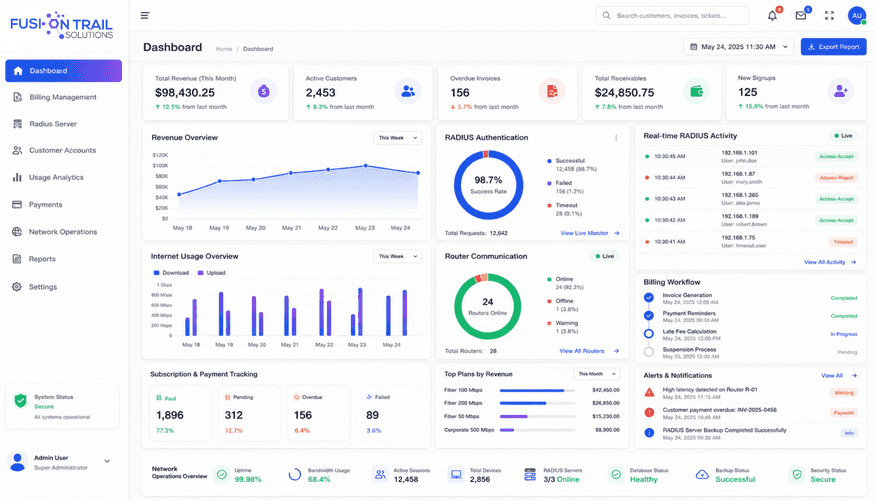
The goal was to bring billing, customer account management, RADIUS integration, payment tracking, usage reporting, and router communication into a centralized management environment.
This was a six-month development project with a production-ready system as its intended deliverable. Our technology stack included React, Node.js, PostgreSQL, a RADIUS server, MikroTik RouterOS, Docker, and AWS.
Rather than treating billing and network management as separate concerns, our approach focused on connecting the relevant components into a more organized operational workflow.
This case study explores the challenges addressed, the technical decisions behind the solution, and the role of structured planning in developing a specialized ISP management platform.
Understanding the Challenges Before Building the Solution
Every meaningful software project begins with understanding the problems that need to be solved.
In ISP operations, different systems often handle different responsibilities. Billing software manages customer charges, authentication systems control network access, and routers provide the infrastructure through which internet services are delivered.
These components have distinct purposes, but their workflows are closely connected.
Our challenge was to develop a management portal that could bring these responsibilities together without losing sight of the technical requirements of each component.
1. Manual Billing Operations
Billing is one of the most important recurring activities for an ISP. Customer accounts, payment records, billing information, and service-related changes need to be managed consistently.
When too many steps depend on manual processing, teams may spend additional time performing routine administrative work.
Manual workflows can also increase the possibility of inconsistent records or delayed updates.
Our solution focused on introducing a centralized internet billing portal to organize billing activities and reduce dependence on repetitive manual processes.
The objective was to make essential billing operations more structured and easier to manage.
2. Complex Router and Network Management
ISP operations depend on communication between customer management systems and network equipment.
MikroTik RouterOS provides network management capabilities, while RADIUS supports authentication and related access-management workflows.
Connecting these components with a business application requires careful consideration of how information moves between systems and how operational changes should be handled.
A billing portal that remains disconnected from network management cannot provide the same level of workflow integration as a system designed to coordinate these responsibilities.
We therefore incorporated RADIUS integration and automated router communication into the project's solution strategy.
3. Delays in Customer Account Processing
Customer account management frequently involves updates related to billing and service administration.
When information must be handled across multiple disconnected tools, processing changes can require additional coordination.
This creates an opportunity to improve how account-related activities are organized.
The portal included customer account management and integrated operational workflows to help address these challenges and support more efficient account handling.
4. Fragmented ISP Workflows
Billing, customer records, payment tracking, router communication, and usage reporting are closely related responsibilities.
Managing them independently can make it more difficult for an operations team to maintain a consistent view of its activities.
Our approach was to establish a centralized platform where these essential functions could operate within a coordinated management environment.
The key principle was simple: instead of solving each operational problem in isolation, we aimed to build a connected solution around the ISP's wider business requirements.
Our Planning Strategy: Building with Purpose
A specialized management portal requires more than a collection of functional screens. It needs a clear understanding of operational requirements, a suitable architecture, and a structured approach to integrating its components.
We organized the development around the relationship between billing operations, customer information, authentication, and network management.
Step 1: Defining the Core Requirements
The first priority was to establish the main functions the portal needed to support.
These included:
Internet billing management
RADIUS server integration
Customer account management
Payment tracking
Usage reporting
Router communication automation
Identifying these functions helped establish the project's scope and technical direction.
It also highlighted an important consideration: the billing system and network infrastructure needed to work together as part of the broader operational process.
Step 2: Designing the Application Architecture
Once the core requirements were established, the next priority was structuring the system.
We used React for the frontend, Node.js and Express-based backend capabilities for application services, PostgreSQL for relational data storage, and REST API patterns for communication between software components.
RADIUS handled the authentication-related integration, while MikroTik RouterOS represented the network management environment.
Docker and AWS formed part of the deployment technology stack.
Each component had a defined responsibility within the overall solution. The objective was to establish a structured foundation that could support the portal's business functionality and technical integrations.
Step 3: Connecting Billing with Authentication Workflows
One of the defining aspects of this project was the relationship between customer billing and network authentication.
These functions cannot simply be treated as unrelated modules. Their operational responsibilities intersect whenever customer account information and network access need to be coordinated.
The portal was designed to bring billing workflows and RADIUS integration into the same management environment.
This helped address the need for a more connected approach to ISP operations.
Step 4: Integrating Router Communication
Network equipment is an essential part of an ISP's service delivery infrastructure.
The project incorporated router communication automation around MikroTik RouterOS, bringing network-related operations into the portal's broader workflow.
This integration was an important part of the solution because it connected the business management layer with the network environment.
Step 5: Preparing a Production-Ready Deliverable
The project was intended to deliver a production-ready system rather than a basic interface demonstration.
That meant the overall solution needed to bring its major components together into a coherent application architecture.
The development objective was to provide a centralized portal that supported the identified operational functions and their relationships.

How We Addressed the Core Technical Challenges
The most important aspect of a specialized software project is the connection between the challenges a business faces and the functionality designed to address them.
For this project, our solution centered on several key areas.
Automated Internet Billing
The billing system was designed to organize ISP billing activities within a centralized portal.
Bringing billing functionality into the management environment helped address the need for more structured operations and reduced dependence on disconnected manual workflows.
The goal was to support more consistent billing administration while keeping customer-related activities connected to the broader system.
RADIUS Server Integration
RADIUS is an important technology in network access management, particularly in ISP environments where subscriber authentication needs to be coordinated with service operations.
Integrating RADIUS with a billing management portal requires attention to the interaction between customer information and authentication-related processes.
Our solution incorporated RADIUS server integration as a core component of the platform.
This established a technical connection between the portal's management functions and the authentication environment.
Customer Account Management
Customer information is central to ISP operations.
Account management needs to fit naturally into the wider billing and network workflow so that teams can handle customer-related activities in an organized way.
The portal included customer account management functionality, providing a dedicated environment for these operational responsibilities.
Payment Tracking
Billing management becomes more useful when payment-related information can be organized alongside customer accounts.
The portal included payment tracking to support the management of payment-related records within the broader billing workflow.
This feature contributed to the goal of creating a centralized environment for ISP administrative operations.
Usage Reporting
Operational visibility is important for managing an internet service business.
Usage reporting was included as a key feature, giving the system a dedicated reporting component alongside billing and customer management.
The objective was to bring reporting into the same platform instead of treating it as an unrelated activity.
Router Communication Automation
The portal also incorporated automated router communication around MikroTik RouterOS.
This was a particularly important part of the architecture because it connected the management application with the network equipment used in ISP operations.
Together with RADIUS integration, router communication helped establish a more coordinated approach to billing and network management.
The Technology Stack Behind the Portal
Selecting appropriate technologies is an important part of building reliable business software. The technologies must support the application's functional requirements while working together as a coherent system.
React: Frontend Development
React was used for the frontend layer of the portal.
Its component-based approach supports the development of structured interfaces and helps organize different areas of the management dashboard.
For a portal with several operational modules, a consistent frontend structure is important for maintaining a coherent user experience.
Node.js: Backend Application Services
Node.js provided the runtime for backend application functionality.
The backend plays an important role in processing application requests, coordinating business logic, and connecting the user interface with the relevant data and integrations.
PostgreSQL: Relational Data Management
PostgreSQL served as the database technology for the project.
Relational database management is particularly relevant to business applications where information such as customer accounts, payment records, and billing data needs to be organized within defined relationships.
RADIUS Server: Authentication Integration
The RADIUS server formed part of the authentication-related architecture.
Its integration with the management portal was central to connecting customer administration with ISP network access workflows.
MikroTik RouterOS: Network Management
MikroTik RouterOS was included as the network management technology around which router communication was integrated.
This helped connect the portal's operational responsibilities with the ISP's network environment.
Docker: Deployment and Environment Management
Docker was part of the project's technology stack, supporting the use of container-based application environments.
Containerization can help standardize how application components are packaged and deployed across supported environments.
AWS: Cloud Infrastructure
AWS formed part of the deployment infrastructure.
Cloud infrastructure is an important consideration for web-based management systems because application services and databases need an appropriate hosting environment.
The overall goal was to bring these technologies together around the requirements of the project rather than selecting tools simply because they were popular.
Quality, Integration, and Reliability
For software that supports essential business operations, quality cannot be measured by appearance alone.
An ISP management portal needs a coherent interface, organized data management, and a clear relationship between its billing, authentication, and network components.
These considerations influenced the overall engineering approach.
Consistency Across Application Components
The frontend, backend, database, and external integrations serve different responsibilities.
Their interactions need to follow a structured design so that the application remains understandable and maintainable.
A well-organized architecture provides a foundation for managing those relationships as the application evolves.
Careful Integration of Network Technologies
Connecting a business portal with RADIUS and router infrastructure requires more than building a user interface.
The integration needs to account for the different roles played by the management application, authentication server, and network equipment.
Keeping those responsibilities clear is an important architectural consideration.
Organized Customer and Payment Information
Customer accounts and payment records are central to billing operations.
A structured database and a dedicated management interface help establish an organized environment for these records.
PostgreSQL provided the relational database foundation for the project.
Deployment Considerations
A production-ready system must also be considered in terms of its deployment environment.
Docker and AWS were included in the project's technology stack, forming part of the deployment architecture.
The wider objective was to deliver a coordinated application rather than isolated components that function independently.
Six Months of Focused Development
The documented project timeline was six months, with a production-ready system as the intended deliverable.
A project of this nature involves several interconnected technical areas. Billing logic, customer management, authentication integration, router communication, and reporting each have their own responsibilities, but their interactions are equally important.
The challenge is to bring these areas together without losing sight of the overall business objective.
That is why requirements planning and architecture matter so much in custom software development.
The focus was on building a centralized management portal that connected the project's core operational functions into one structured environment.
Project Outcomes: A More Connected Approach to ISP Operations
The project was designed to address operational fragmentation and reduce the amount of manual work associated with ISP billing and management.
The documented outcomes included:
Reduced manual billing workload
Improved operational efficiency
Faster customer account management
Better network workflow automation
These outcomes reflect the core purpose of the portal: bringing important operational activities into a coordinated management system.
By incorporating billing, RADIUS integration, customer account management, payment tracking, usage reporting, and router communication, the solution addressed several connected areas of ISP operations.
Rather than managing each function in isolation, the portal provided a centralized environment designed to support a more organized operational process.
No unverified percentage improvements or financial savings are claimed here; the outcomes are described in line with the published case study.

What This Project Demonstrates About Our Development Approach
The Internet Billing and RADIUS Management Portal demonstrates the importance of understanding a business's operational environment before designing its software solution.
It also highlights the value of treating integrations as part of the core architecture rather than as secondary additions.
Several principles stand out.
Start with the operational problem. Understanding billing, customer management, and network workflows helps define what the software actually needs to accomplish.
Plan the architecture carefully. Frontend, backend, database, authentication, and network components must work together within a coherent structure.
Treat integrations as essential. RADIUS and MikroTik communication were central to the project's purpose, making them important parts of the overall solution.
Keep business functions connected. Billing, payment tracking, customer accounts, and usage reporting are more useful when they support a coordinated management workflow.
Build for practical use. The objective of custom software is to address real operational requirements through a solution that brings the necessary functionality together.
These principles apply not only to ISP billing platforms but also to other business applications involving multiple connected systems.
Why Internet Billing and RADIUS Management Software Matters
As internet service providers manage their customer bases and network operations, coordinating billing and network access becomes an important operational consideration.
An ISP billing and RADIUS management portal can help bring customer administration, payment tracking, billing workflows, and authentication-related processes into a centralized environment.
However, the right solution depends on the provider's existing infrastructure, operational requirements, network equipment, and business goals.
For some providers, an existing billing platform may be sufficient. Others may require custom software to connect systems, organize workflows, or address specific operational needs.
The most important step is to identify the actual challenges and choose an architecture that supports them.
This project reflects that principle by combining billing management with RADIUS integration and router communication within one dedicated portal.
Conclusion: Engineering a Better Connected ISP Workflow
Building an Internet Billing and RADIUS Management Portal required a business-focused approach to software development, with attention to billing operations, customer account management, authentication, and network integration.
Over a six-month project timeline, Fusion Trail Solutions worked toward a production-ready solution built with React, Node.js, PostgreSQL, RADIUS, MikroTik RouterOS, Docker, and AWS.
The portal brought together internet billing, customer account management, payment tracking, usage reporting, and router communication automation within a centralized management environment.
The broader lesson is that effective software development involves more than choosing technologies and implementing features. It requires understanding how a business operates, identifying the relationships between its systems, and designing a solution around those needs.
At Fusion Trail Solutions, we focus on developing custom software solutions that help businesses organize complex workflows, connect essential systems, and move toward more efficient digital operations.
Looking to develop a custom billing portal, network management platform, or business automation solution? Explore our work and discover how a carefully planned software solution can help address your operational challenges.
Explore the project: https://www.fusiontrailsolutions.com/case-studies/internet-billing-radius-management-portal
Learn more about Fusion Trail Solutions: https://www.fusiontrailsolutions.com/