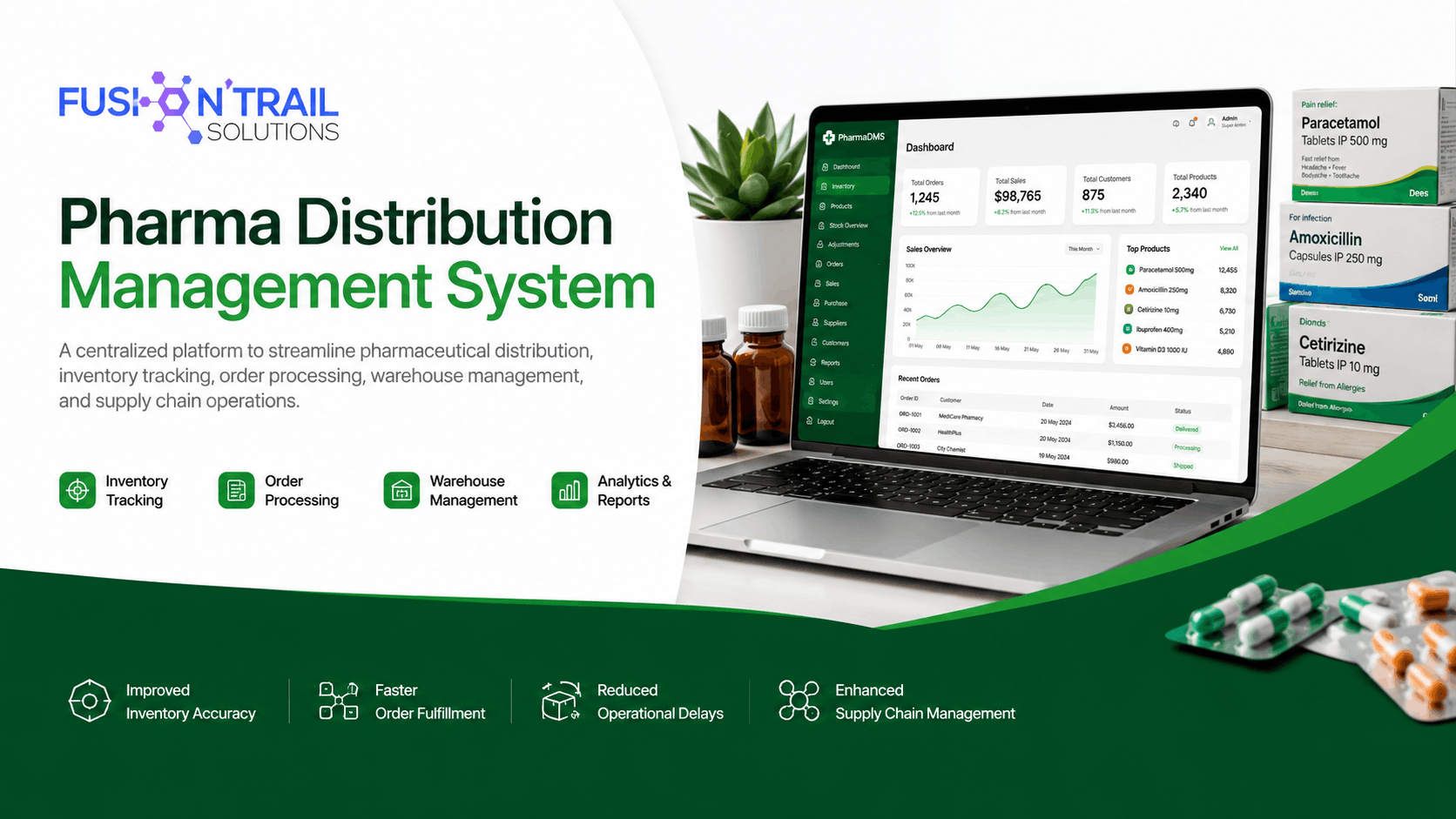
Introduction: Bringing Accuracy and Efficiency to Pharmaceutical Distribution
The pharmaceutical distribution industry plays a critical role in connecting medicine manufacturers, distributors, warehouses, pharmacies, and healthcare providers. Behind every successful distribution operation, there are multiple processes that must work together, including inventory management, order processing, warehouse operations, sales coordination, and supply chain tracking.
Managing these activities efficiently requires more than maintaining product lists or recording orders. Pharmaceutical distributors need organized workflows, accurate inventory information, reliable reporting, and better visibility into their day-to-day operations.
When these processes depend on manual records or disconnected systems, businesses may experience inventory inconsistencies, delayed order fulfillment, inefficient warehouse operations, and difficulties tracking distribution activities.
At Fusion Trail Solutions, we approached these challenges through the development of a custom Pharma Distribution Management System designed to bring essential distribution and inventory operations into one centralized digital platform.
The objective was to create a structured management environment where businesses could manage inventory, process orders, coordinate warehouse activities, analyze distribution operations, and access important business reports.
Over a six-month development timeline, our focus was on building a production-ready system using React, Node.js, PostgreSQL, AWS, Docker, and REST APIs.
This project was not simply about developing another business dashboard. It was about understanding the operational requirements of pharmaceutical distribution and translating them into a practical software solution.
In this case study, we explore the business challenges behind the project, our development strategy, the technical architecture, and the importance of building reliable software for inventory-intensive operations.
Understanding the Challenges Before Writing Code
Every successful custom software project begins with understanding the problems the business needs to solve.
In pharmaceutical distribution, inventory records, customer orders, warehouse activities, and distribution information are closely connected. An issue in one area can affect the efficiency of other operational processes.
For example, inaccurate inventory information can complicate order fulfillment, while poorly coordinated warehouse workflows can create delays in preparing and dispatching orders.
Our development approach focused on addressing four major challenges.
1. Manual Inventory Management
Inventory is one of the most important components of pharmaceutical distribution.
Distributors need to maintain organized records of available products and ensure that inventory information reflects actual operational activity.
When inventory management relies heavily on manual processes, maintaining accurate records can become difficult. Repeated data entry and disconnected records can also increase the risk of inconsistencies.
Our solution focused on introducing a centralized inventory management system to organize inventory tracking and improve visibility into inventory-related operations.
The objective was to provide a more structured approach to managing inventory information rather than relying entirely on fragmented manual workflows.
2. Delayed Order Processing
Order processing involves multiple activities, from receiving an order to coordinating its preparation and fulfillment.
When these activities are not properly connected, employees may need additional time to verify information, coordinate with warehouse teams, or identify the status of an order.
These delays can affect the overall efficiency of distribution operations.
We addressed this requirement by incorporating order management and order processing automation into the platform.
The goal was to establish a more organized workflow for handling orders and coordinating related activities.
3. Lack of Centralized Distribution Tracking
Pharmaceutical distribution involves several interconnected operational functions.
When inventory, orders, warehouse activities, and reporting are managed separately, it can become difficult to maintain a clear overview of the business.
A centralized system can help bring relevant information together and provide a more consistent management experience.
Our approach focused on developing a unified platform where essential distribution activities could be managed through connected modules.
4. Inefficient Warehouse Workflows
Warehouse operations are closely connected to inventory accuracy and order fulfillment.
When warehouse activities depend on disconnected processes, coordinating product handling and order preparation can become more complicated.
We incorporated warehouse management functionality into the platform to help organize these operations within the wider distribution workflow.
The objective was to create a system where warehouse activities supported the same operational process as inventory and order management.
These challenges established the direction of the project: build a centralized platform that could support the business's major distribution activities through a coordinated digital environment.
Our Development Strategy: Planning Before Implementation
Developing a pharmaceutical distribution platform requires more than creating separate screens for inventory, orders, and reporting.
The underlying system must account for the relationships between these functions and provide a consistent way to manage their information.
At Fusion Trail Solutions, our approach centered on understanding operational requirements, designing the application architecture, organizing business modules, and preparing a production-ready solution.
Step 1: Identifying Core Business Requirements
The first priority was to establish the main operational areas the system needed to support.
These included:
Inventory tracking and management
Order processing and order management
Warehouse operations
Distribution analytics
Reporting dashboard
User role management
Organizing these requirements helped establish the project's functional scope.
It also made the relationships between inventory, orders, warehouses, and reporting central to the overall development strategy.
Step 2: Designing a Structured Application Architecture
Once the core requirements were defined, the next priority was establishing a suitable technical foundation.
We used React for frontend development, Node.js for backend application services, PostgreSQL for relational data management, and REST APIs for communication between application components.
AWS was included as part of the cloud infrastructure, while Docker formed part of the deployment technology stack.
Each component served a distinct purpose.
The frontend provided the management interface, the backend supported application functionality, PostgreSQL managed relational data, and REST APIs connected the relevant components.
This structure provided a foundation for organizing the platform's different business modules within a unified application.
Step 3: Organizing Inventory and Order Workflows
Inventory and order management are closely connected in distribution businesses.
Order processing depends on relevant product and inventory information, while inventory records need to reflect the activities supported by the management system.
We organized the platform around these connected requirements rather than treating inventory and orders as entirely independent features.
This helped align the system's functional design with the practical needs of distribution operations.
Step 4: Integrating Warehouse Management
Warehouse operations represent another important part of the distribution process.
A management platform needs to support warehouse-related activities alongside inventory and order workflows.
We incorporated warehouse management functionality to provide a dedicated area for these operations within the centralized system.
The goal was to support a more coordinated distribution process rather than leaving warehouse activities disconnected from the broader management environment.
Step 5: Building Reporting and Administrative Capabilities
Operational visibility is essential for managing distribution activities.
Businesses need organized information to review their operations and understand the status of relevant activities.
The platform therefore included distribution analytics, a reporting dashboard, and user role management.
These features helped establish a centralized environment for operational reporting and administrative control.

How We Addressed the Core Operational Challenges
The real value of a custom software solution comes from how effectively it connects business requirements with practical functionality.
For this project, we focused on creating an integrated management environment for inventory, orders, warehouses, and distribution reporting.
Centralized Inventory Tracking
Inventory tracking was a central feature of the platform.
The system was designed to organize inventory-related information within a dedicated management environment, supporting the project's objective of improving inventory accuracy.
A centralized inventory workflow can help reduce dependence on scattered records and provide a clearer basis for managing product information.
For pharmaceutical distributors, this is particularly important because inventory information is closely connected to order processing and warehouse operations.
Where required by the business, a more advanced pharmaceutical inventory solution may also incorporate batch numbers, expiry dates, and stock rotation policies. Such capabilities should be confirmed against the actual project requirements rather than assumed to be implemented.
Structured Order Management
Order management was another core component of the platform.
The system provided a dedicated environment for organizing order-related activities and supporting the broader distribution workflow.
By bringing order management together with inventory and warehouse functionality, the platform was designed to help businesses coordinate their operational activities more effectively.
The objective was to establish a clearer process for handling orders and reduce unnecessary operational delays.
Organized Warehouse Operations
Warehouse management functionality brought warehouse-related activities into the centralized platform.
This was important because inventory records and order fulfillment depend on organized warehouse operations.
When these activities are managed within a coordinated system, businesses have a stronger foundation for improving operational visibility and reducing unnecessary fragmentation.
The platform's warehouse management component supported this broader objective.
Distribution Analytics and Reporting
Distribution businesses need more than operational records; they also need ways to review and understand their activities.
The platform included distribution analytics and a reporting dashboard to support this requirement.
These features provided a dedicated environment for accessing relevant operational information.
The broader objective was to make reporting part of the management workflow rather than treating it as a separate activity.
User Role Management
Different employees may have different responsibilities within a distribution business.
A centralized management platform therefore benefits from clearly organized user roles and appropriate access permissions.
The system included user role management to support differentiated access within the application.
This helped establish an administrative structure suited to a multi-function business management platform.
Technology Stack: The Foundation Behind the System
Choosing the right technology stack is an important part of custom software development.
The selected technologies must support the application's requirements while providing a maintainable foundation for future development.
For this project, our stack included React, Node.js, PostgreSQL, AWS, Docker, and REST APIs.
React: Frontend Development
React powered the frontend interface.
Its component-based architecture supports the development of reusable interface elements and helps organize the different sections of a management application.
For a distribution platform, a structured interface is important because users need to work with several related functions, including inventory, orders, warehouse operations, and reports.
Node.js: Backend Application Services
Node.js provided the runtime for backend application functionality.
The backend is responsible for supporting application logic and coordinating requests between the frontend, database, and relevant services.
A well-organized backend is important for applications that manage interconnected business processes.
PostgreSQL: Relational Database Management
PostgreSQL served as the database technology for the project.
Distribution systems manage related information, including inventory records, orders, warehouse activities, and reporting data.
A relational database provides a structured foundation for managing these relationships and maintaining consistency across relevant records.
REST APIs: Connecting Application Components
REST APIs provided the communication layer between application components.
A clear API structure helps organize how the frontend communicates with backend services and how different application functions exchange information.
This was an important part of connecting the platform's inventory, order management, warehouse, and reporting capabilities.
AWS: Cloud Infrastructure
AWS formed part of the platform's cloud infrastructure.
Cloud infrastructure can provide a foundation for hosting application services and supporting the operational needs of a business management system.
The appropriate configuration depends on requirements such as performance, availability, security, and deployment architecture.
Docker: Deployment and Environment Management
Docker was included in the project's technology stack.
Containerization can help standardize application environments and support more consistent deployment practices.
Together, these technologies provided the technical foundation for the platform's application architecture.

Quality Was an Important Part of the Development Approach
A business management system needs to do more than present information through a modern interface.
Its modules must work together, its data must be organized appropriately, and its workflows must reflect the requirements of the business.
For a pharmaceutical distribution platform, these considerations are particularly important because inventory and order information directly influence daily operational decisions.
Data Consistency
Inventory and order records need to remain consistent across relevant application workflows.
A structured database design and clearly defined application logic provide a foundation for managing these relationships.
Maintaining accurate inventory information was a central objective of the project.
Organized Business Workflows
Inventory, order processing, warehouse operations, and reporting serve different purposes, but they are closely connected.
Organizing these functions within one platform helps establish a more consistent operational environment.
This was a key consideration in the overall system design.
Access Management
A centralized platform may serve employees with different operational responsibilities.
User role management helps establish an organized approach to application access and supports the separation of responsibilities.
The specific permissions should reflect the actual needs of the business.
Maintainable Architecture
Business requirements evolve over time.
A well-structured application architecture makes it easier to understand how different modules interact and provides a foundation for future improvements.
The combination of React, Node.js, PostgreSQL, REST APIs, Docker, and AWS supported the project's technical structure.
Production Readiness
A production-ready application requires more than a working development build.
It needs an organized architecture, appropriate deployment configuration, coherent workflows, and careful integration between its components.
The intended deliverable for this project was a production-ready pharmaceutical distribution management system.
Six Months of Focused Development
The documented timeline for this project was six months.
A platform involving inventory management, order processing, warehouse operations, reporting, and administrative controls requires attention to both individual features and the relationships between them.
For example, inventory information needs to support order management, while warehouse activities need to fit into the broader distribution process.
Reporting must also reflect the information maintained by the system.
These relationships make requirements planning and application architecture important parts of the development process.
Our focus was to bring the major operational functions together into a centralized platform designed around pharmaceutical distribution requirements.
Project Results: Improving Inventory Accuracy and Distribution Efficiency
The Pharma Distribution Management System was designed to address operational fragmentation and improve the way inventory, orders, and warehouse activities were managed.
The documented project outcomes included:
Improved inventory accuracy
Faster order fulfillment
Reduced operational delays
Enhanced supply chain management
These outcomes reflect the project's central objective: establishing a more organized approach to pharmaceutical distribution operations.
By bringing inventory tracking, order management, warehouse operations, distribution analytics, reporting, and user role management into one platform, the solution addressed several connected business requirements.
Improved inventory accuracy was the highlighted key result, while the other outcomes reflected the broader operational goals of the system.
No unsupported percentage improvements or financial savings are claimed here because verified numerical measurements were not provided in the published case study.
What This Project Demonstrates About Our Development Approach
This project demonstrates the importance of connecting technical decisions with real business requirements.
A pharmaceutical distribution system must support the way products, orders, warehouses, and operational information relate to one another.
Several development principles stand out.
Understand the business first. Identify the operational challenges before deciding which features to build.
Plan the architecture carefully. The frontend, backend, database, and APIs need to work together within a structured system.
Design around connected workflows. Inventory, orders, and warehouse activities should support a coordinated operational process.
Prioritize data consistency. Inventory and order information need to be organized carefully to support dependable business operations.
Build for maintainability. A structured application makes future improvements easier to plan and implement.
Focus on practical outcomes. The purpose of a management platform is to help businesses organize their operations and address real workflow challenges.
These principles are relevant to pharmaceutical distributors and other businesses that manage complex inventory and supply chain operations.
Why Pharmaceutical Distribution Management Software Matters
Pharmaceutical distributors operate in an environment where inventory, order fulfillment, warehouse coordination, and reporting are closely connected.
Managing these activities through disconnected systems can make it harder to maintain consistent records and coordinate day-to-day operations.
A pharmaceutical distribution management system can bring these functions together in one digital environment, supporting better inventory visibility and more organized workflows.
Depending on business requirements, more specialized systems may also need to support batch traceability, expiry-date monitoring, product recall workflows, temperature-controlled logistics, and applicable pharmaceutical regulations.
These requirements should be evaluated according to the distributor's operating model and the jurisdictions in which it works.
The most effective solution is one that addresses the actual needs of the business rather than introducing unnecessary complexity.
This project reflects that principle by focusing on centralized inventory management, order processing, warehouse operations, distribution analytics, and administrative controls.
Conclusion: Building a Stronger Foundation for Pharmaceutical Distribution
The Pharma Distribution Management System project focused on bringing essential pharmaceutical distribution activities into a centralized digital platform.
Over a six-month development timeline, Fusion Trail Solutions worked toward delivering a production-ready solution using React, Node.js, PostgreSQL, AWS, Docker, and REST APIs.
The platform brought together inventory tracking, order management, warehouse operations, distribution analytics, reporting, and user role management.
The project's highlighted result was improved inventory accuracy, supported by broader objectives around order fulfillment, operational efficiency, and supply chain management.
More importantly, this case study demonstrates that effective software development requires more than implementing individual features. It requires understanding the business, planning the architecture, organizing connected workflows, and developing a solution around practical operational needs.
At Fusion Trail Solutions, we focus on building custom software solutions that help businesses streamline operations, connect essential processes, and establish a stronger foundation for digital growth.
Looking for a custom pharmaceutical distribution or inventory management solution? Explore our work and discover how purpose-built software can help transform complex business operations into more organized digital workflows.
Explore the project: https://www.fusiontrailsolutions.com/case-studies/pharma-distribution-management-system
Learn more about Fusion Trail Solutions: https://www.fusiontrailsolutions.com/