
zHBM Memory Architecture: The Future of AI Computing and High-Performance Memory
Artificial Intelligence is evolving at an incredible pace, but modern AI models demand more than just faster processors they require revolutionary memory technology. Traditional memory systems are becoming one of the biggest bottlenecks for training and running large AI models.
To solve this challenge, semiconductor companies are introducing zHBM (Vertical High-Bandwidth Memory), an advanced 3D memory architecture that vertically stacks high-bandwidth memory directly above AI accelerators. This innovative approach promises significantly higher bandwidth, reduced latency, lower power consumption, and massive improvements in AI performance.
In this article, we'll explore how zHBM works, why it matters, and how it could reshape the future of AI infrastructure.
What Is zHBM?
zHBM stands for Vertical High-Bandwidth Memory, a next-generation memory architecture designed specifically for AI workloads.
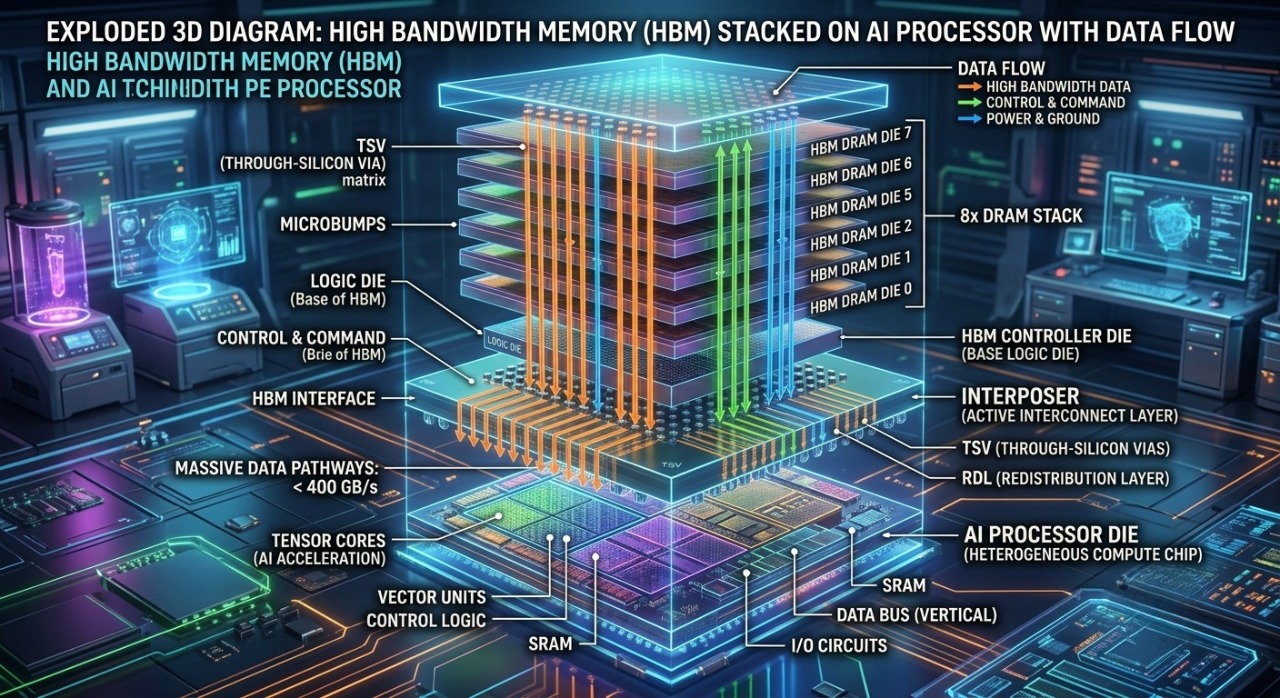
Instead of placing memory chips beside AI processors, zHBM stacks memory vertically on top of AI accelerators using advanced 3D packaging technologies. This dramatically shortens the distance data must travel, allowing AI chips to access information much faster than traditional memory designs.
The result is a smarter, faster, and more energy-efficient computing platform capable of handling increasingly complex AI models.
Why Traditional Memory Is Becoming a Bottleneck
Modern AI models contain billions—or even trillions—of parameters.
Although AI accelerators continue becoming faster, they often spend valuable time waiting for data from memory. This limitation is known as the memory bottleneck.
Common challenges include:
High memory latency
Limited memory bandwidth
Increased power consumption
Slower AI model training
Reduced inference performance
As AI models continue growing, solving these problems has become one of the industry's highest priorities.
How zHBM Works
The biggest innovation behind zHBM is vertical memory stacking.
Rather than connecting memory through longer PCB traces, multiple High-Bandwidth Memory (HBM) layers are stacked directly above the AI compute chip using advanced chip packaging and high-density interconnects.
This design enables:
Extremely high data transfer speeds
Lower communication delays
Better thermal optimization
Improved energy efficiency
Higher memory capacity in a compact footprint
The shorter physical distance between compute and memory allows AI accelerators to process enormous datasets with much greater efficiency.
Key Benefits of zHBM Architecture
1. Massive Memory Bandwidth
AI workloads constantly move huge amounts of data.
zHBM delivers significantly higher bandwidth, ensuring AI processors remain fully utilized instead of waiting for memory access.
2. Lower Latency
By placing memory directly above the processor, data reaches the compute cores much faster.
Lower latency translates into quicker inference and faster AI responses.
3. Better Power Efficiency
Moving data across shorter distances requires less energy.
This helps reduce power consumption inside AI servers while improving overall performance per watt.
4. Higher AI Training Speed
Large language models, computer vision systems, and generative AI applications require enormous memory throughput.
zHBM can dramatically reduce training time by feeding GPUs and AI accelerators with data more efficiently.
5. Improved Data Center Performance
Modern AI data centers run thousands of accelerators simultaneously.
Higher bandwidth memory allows these systems to achieve greater throughput while reducing infrastructure bottlenecks.

Industries That Could Benefit
The impact of zHBM extends beyond AI research.
Industries likely to benefit include:
Artificial Intelligence
Machine Learning
Robotics
Autonomous Vehicles
Healthcare AI
Scientific Computing
Financial Modeling
Cloud Computing
High-Performance Computing (HPC)
Edge AI
Challenges Ahead
Despite its advantages, zHBM also introduces several engineering challenges.
These include:
Higher manufacturing costs
Complex chip packaging
Heat management
Yield optimization
Supply chain scalability
However, ongoing innovations in semiconductor manufacturing are expected to make advanced memory architectures more practical and cost-effective over time.
The Future of AI Memory
As AI models become increasingly sophisticated, memory innovation will play an equally important role as processor innovation.
Technologies like zHBM represent a significant step toward eliminating one of AI computing's biggest limitations. By bringing memory physically closer to AI accelerators, future systems can achieve faster processing, lower energy consumption, and better scalability for next-generation AI applications.
Experts expect advanced 3D memory architectures to become a core component of future AI hardware, enabling more powerful data centers, smarter edge devices, and increasingly capable generative AI systems.

Final Thoughts
The introduction of zHBM marks an important milestone in semiconductor innovation. Rather than simply building faster processors, the industry is rethinking how memory and compute work together.
With vertical stacking, ultra-high bandwidth, lower latency, and improved energy efficiency, zHBM has the potential to redefine AI infrastructure for years to come.
As demand for generative AI, large language models, and high-performance computing continues to rise, advanced memory architectures like zHBM may become one of the most important technologies powering the next generation of artificial intelligence.