The AI industry is moving at an incredible pace, and every new model brings a fresh question: Is it genuinely better, or is it just another upgrade with a bigger headline?
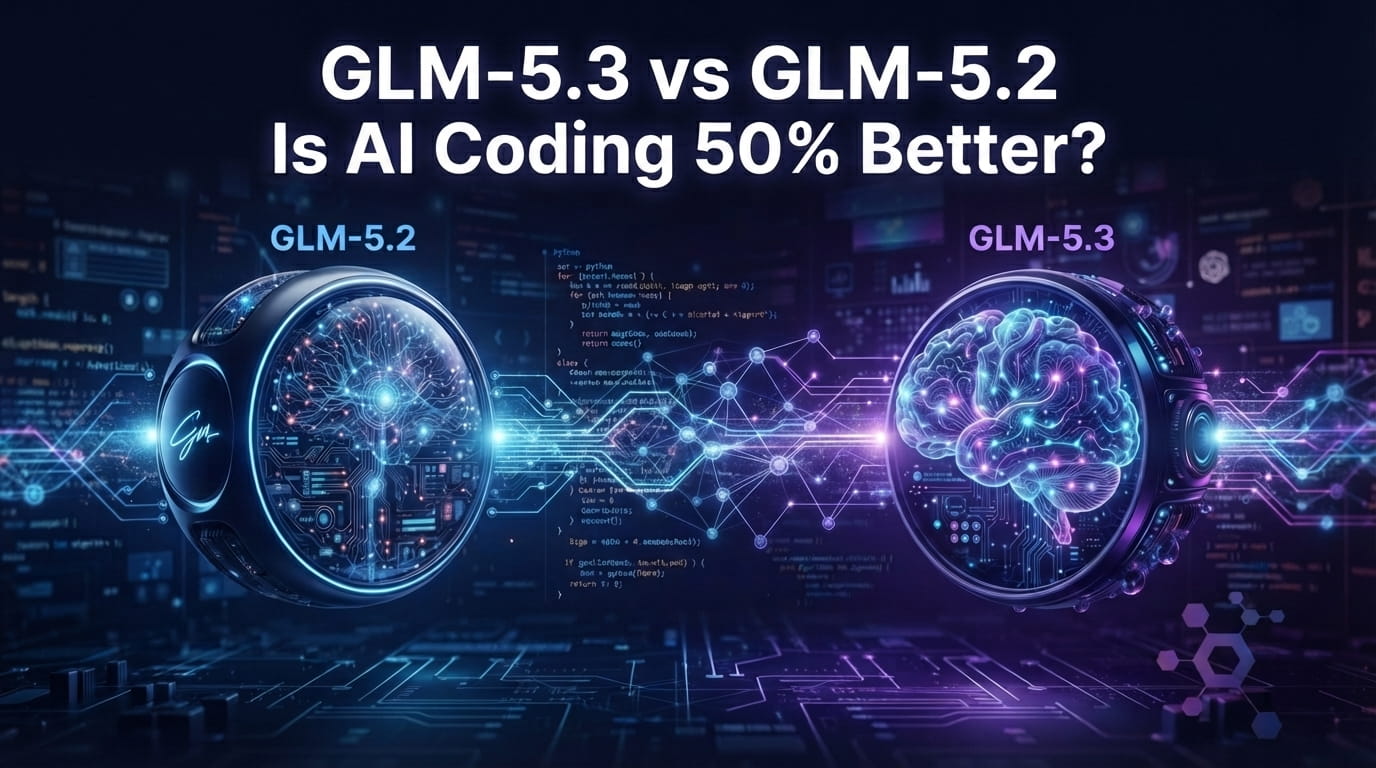
Z.ai has entered that conversation with GLM-5.3, the successor to GLM-5.2. The company claims that its latest model delivers a 50% improvement in coding performance on its internal Z.ai Code Bench. That announcement has attracted attention from software developers, AI enthusiasts, coding-agent users, and businesses exploring more capable AI systems.
But what does a 50% improvement actually mean? Is GLM-5.3 faster, smarter, or simply better at complex programming tasks? And does GLM-5.2 still have a place in the rapidly evolving AI landscape?
In this detailed GLM-5.3 vs GLM-5.2 comparison, we examine the company's claims, publicly reported benchmark results, coding capabilities, cybersecurity performance, and practical implications for developers. The goal is to understand what has changed, where the improvements matter, and which model may be the better fit for different workloads.
What Are GLM-5.3 and GLM-5.2?
GLM is a family of AI models developed by Z.ai, formerly known as Zhipu AI. The models are designed for demanding tasks such as software development, reasoning, long-running workflows, and AI-agent operations.
GLM-5.2 introduced significant capabilities for complex tasks, including support for a one-million-token context window. It was designed to work on substantial projects that require more than a single response.
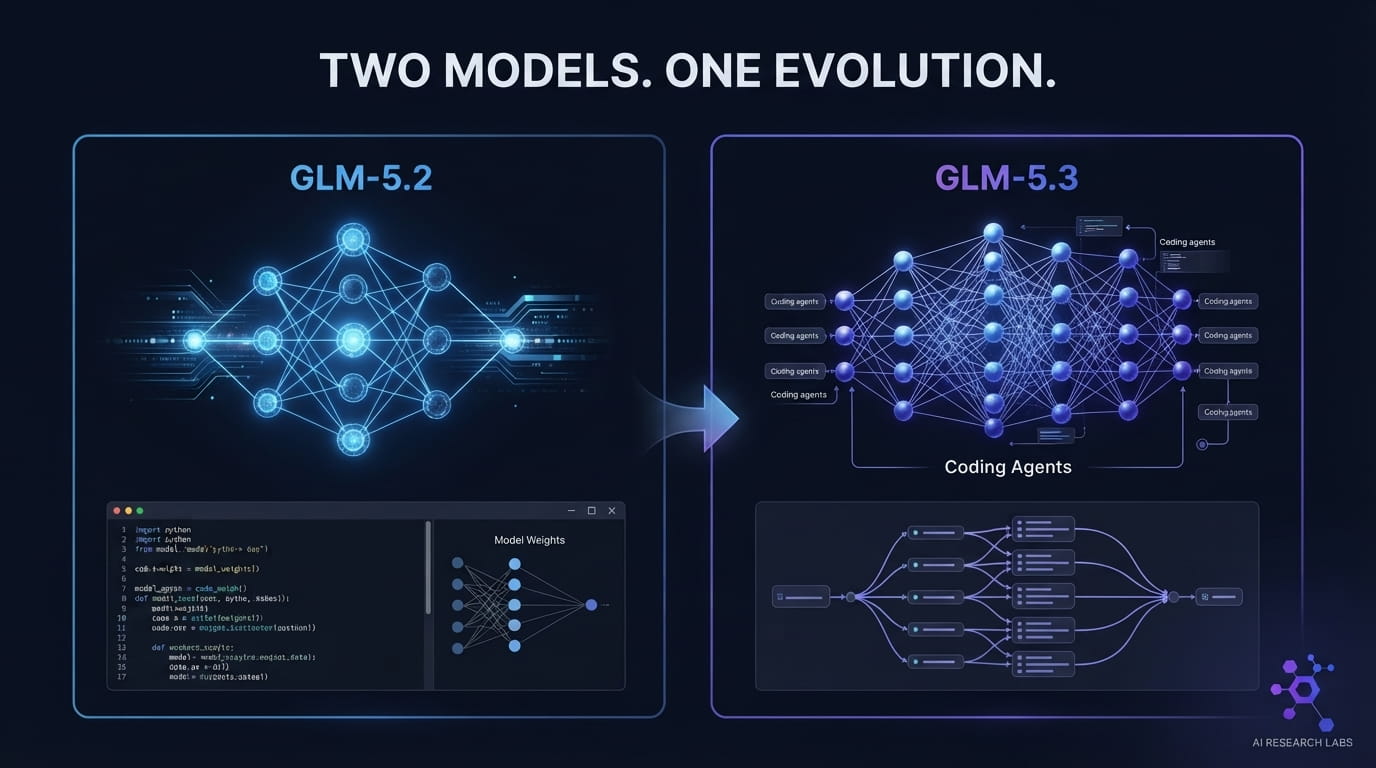
GLM-5.3 takes the next step. According to Z.ai, it uses the same underlying base model as GLM-5.2, with improvements coming from additional post-training, more diverse task environments, and increased computational effort during training.
This distinction is important. GLM-5.3 is not simply a completely new model with a different name. It builds on the existing foundation and aims to make that foundation more capable at solving difficult problems.
For developers, the central question is whether those training improvements translate into better code, more reliable problem-solving, and stronger performance across real-world projects.
GLM-5.3 vs GLM-5.2: Key Differences at a Glance
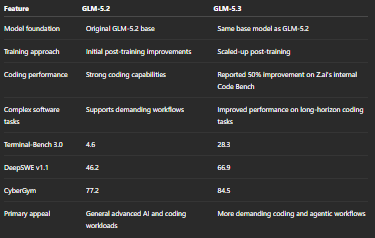
Benchmark figures are reported by Z.ai. Results depend on the evaluation method and should not be treated as universal measurements of every AI capability.
Source: Z.ai's official GLM-5.3 announcement.
The 50% Improvement Claim: What Does It Really Mean?
The headline figure is undoubtedly the most attention-grabbing part of the GLM-5.3 announcement.
Z.ai reports a 50% improvement over GLM-5.2 on its in-house Z.ai Code Bench. This suggests that the newer model has become substantially more capable at the coding tasks measured by that evaluation.
However, there is an important distinction between coding performance and overall AI performance.
A 50% improvement on a particular benchmark does not necessarily mean that every answer is 50% better, that responses arrive 50% faster, or that the model is 50% more intelligent across every subject.
Benchmark improvements depend on the tasks being tested, the scoring methodology, and the conditions under which the models are evaluated.
For example, a coding benchmark may measure whether an AI system can complete a programming task successfully. It does not automatically measure how quickly the system responds, how well it writes marketing content, or how accurately it answers every factual question.
The strongest interpretation of Z.ai's claim is therefore that GLM-5.3 demonstrates a reported 50% improvement in coding performance on the company's own benchmark, rather than a universal 50% improvement in response quality.
For anyone evaluating AI models professionally, that distinction matters.
Public Benchmark Results: Where GLM-5.3 Makes a Difference
The internal benchmark claim becomes more interesting when considered alongside the public benchmark results published by Z.ai.
1. Terminal-Bench 3.0: A Significant Coding Improvement
Terminal-Bench evaluates AI systems on tasks involving terminal-based workflows and practical computer operations.
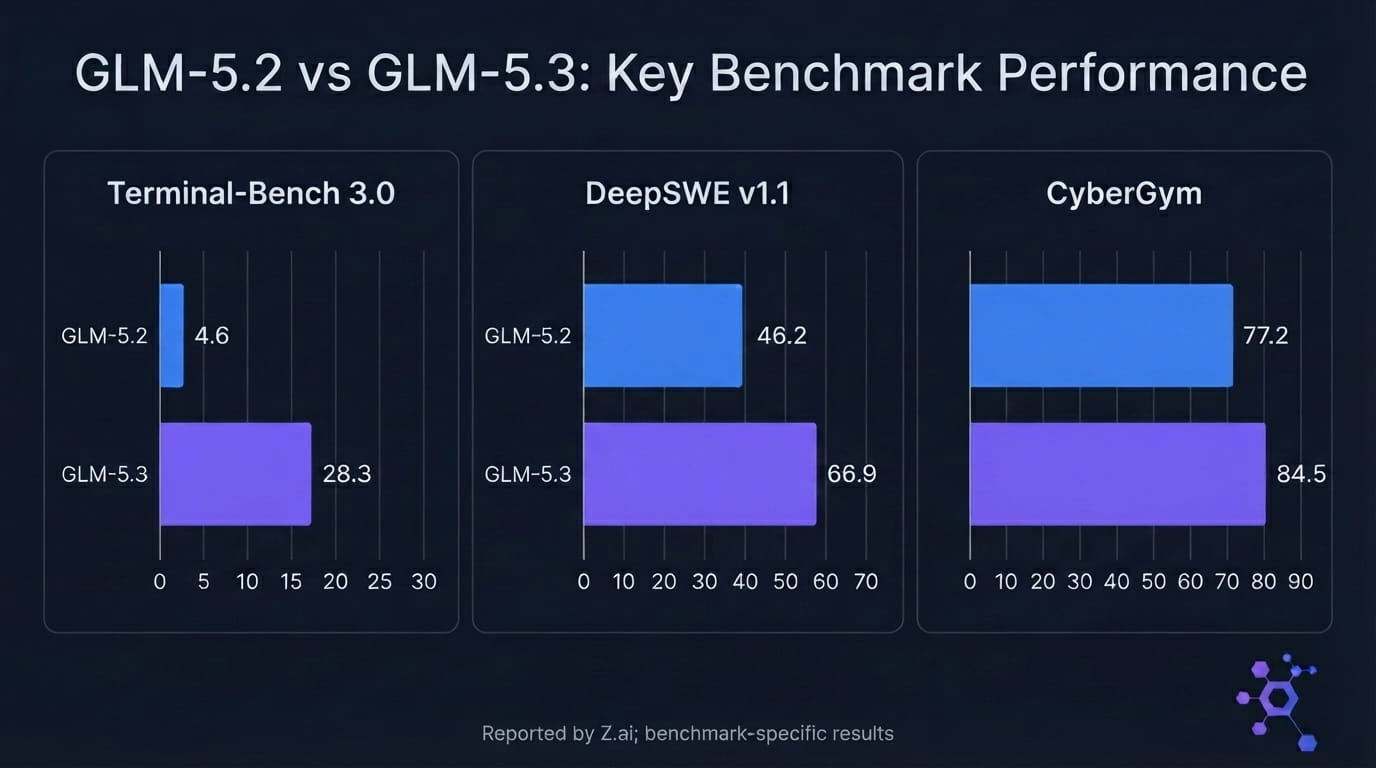
Z.ai reports the following scores:
GLM-5.2: 4.6
GLM-5.3: 28.3
This represents a substantial increase on the reported evaluation. It suggests that GLM-5.3 has become considerably more capable on this particular set of tasks.
For developers using AI agents to work with repositories, execute commands, investigate errors, or complete multi-step engineering jobs, this is a noteworthy result.
Nevertheless, a higher benchmark score does not guarantee the same improvement in every developer's environment. Actual results depend on the tools available, the complexity of the repository, and the quality of the task instructions.
2. DeepSWE v1.1: Better Performance on Software Engineering Tasks
Z.ai reports a DeepSWE v1.1 score of 66.9 for GLM-5.3, compared with 46.2 for GLM-5.2.
This improvement provides additional evidence that the newer model is better equipped for the evaluated software engineering workload.
It is particularly relevant to developers who want AI assistance with codebases rather than isolated code snippets.
Potential applications include investigating existing code, implementing requested changes, debugging complex issues, and working through tasks that require multiple steps.
The real-world value still depends on whether the model can produce correct, maintainable code in the specific project being developed.
3. CyberGym: Improved Vulnerability Discovery
Cybersecurity is another area highlighted in Z.ai's announcement.
The company reports CyberGym scores of 84.5 for GLM-5.3 and 77.2 for GLM-5.2. CyberGym evaluates capabilities associated with discovering software vulnerabilities.
These results suggest improved performance on the benchmark's vulnerability-discovery tasks.
For security researchers and software teams, this area of AI development is important because automated systems may help identify weaknesses and support defensive security testing.
However, vulnerability discovery and successful exploitation are different capabilities. A strong result in one does not automatically mean the same level of performance in the other.
Cybersecurity-related AI should be evaluated carefully, with appropriate safeguards and authorized testing environments.
Is GLM-5.3 Faster Than GLM-5.2?
This is one of the most important questions for people who interpret the 50% improvement claim as a speed upgrade.
Higher coding performance does not automatically mean faster response times.
An AI model can become more successful at solving difficult tasks while still requiring considerable time to reason through them. Response speed can also vary depending on the provider, hardware, server load, output length, and reasoning settings.
For example, if GLM-5.3 takes longer to analyze a complicated software bug but produces a working solution more often, it may still save a developer time overall.
Conversely, someone who primarily asks short questions or generates simple code snippets may notice a smaller practical difference.
To establish which model is faster, users should compare time to first token, total completion time, tokens per second, and time required to finish the same task successfully.
The available 50% coding-improvement claim alone does not establish a 50% increase in response speed.
Why GLM-5.3 Could Matter for AI Coding Agents
Modern AI development is moving beyond asking a chatbot to generate a single function. Developers increasingly want AI systems that can work through an entire task, inspect files, run tests, interpret errors, and revise their solutions.
This is where the concept of long-horizon tasks becomes especially important.
A long-horizon task involves multiple dependent steps. The AI must maintain context, respond to new information, and continue working toward a final objective instead of stopping after an initial answer.
GLM-5.3's reported improvements in coding and agent-oriented benchmarks make it particularly interesting for this category of work.
Potential use cases include:
Building features across multiple application files.
Debugging complicated errors in existing projects.
Refactoring code while preserving existing functionality.
Working with terminal-based development tools.
Investigating test failures and proposing fixes.
Supporting multi-step software engineering workflows.
These are potential applications, not guarantees. Developers should still review generated changes, run tests, check dependencies, and verify that the resulting application behaves as expected.
For teams that already rely on AI-assisted development, GLM-5.3 deserves consideration through practical testing rather than assumptions based solely on marketing claims.
Which Model Is Better for Different Users?
The answer depends on what you need from an AI model.
For Software Developers
GLM-5.3 is the more compelling candidate to evaluate for complex coding tasks because Z.ai reports stronger results on its coding benchmark and several public evaluations.
Developers working on large applications, unfamiliar codebases, or multi-step engineering problems may benefit most from testing the newer model.
For AI Agent Workflows
GLM-5.3 is worth evaluating when a task requires repeated tool use, repository inspection, debugging, and multiple rounds of refinement.
However, a successful deployment depends on the entire agent setup, including tool permissions, context management, testing, and error recovery.
For General AI Users
People who mainly use AI for everyday questions, brainstorming, summaries, or basic writing may not experience the same level of improvement reported on coding benchmarks.
For these users, answer quality, cost, availability, and response speed may matter more than a specialized coding score.
For Businesses
Companies should assess the model against their own workloads before migrating production systems.
A controlled evaluation can compare success rates, operating costs, latency, security requirements, and the amount of human correction required.
A newer model is valuable when it improves business outcomes, not merely when it produces a higher score in a particular test.
Is GLM-5.2 Still Relevant?
Absolutely. GLM-5.2 remains an important comparison point because it already introduced strong capabilities for advanced AI workloads.
The U.S. National Institute of Standards and Technology's Center for AI Standards and Innovation assessed GLM-5.2 in July 2026 and reported that it was probably the most capable open-weight model when it was released. That assessment provides useful historical context for understanding the level of capability the earlier model had already achieved.
GLM-5.3's progress is therefore notable because it builds on an already capable foundation rather than starting from an entirely unrelated model.
There may still be reasons to retain GLM-5.2 in an existing workflow, including compatibility, established testing results, or deployment requirements. Any decision to switch should consider those practical factors.
Source: NIST — CAISI Assessment of GLM-5.2.
GLM-5.3 vs GLM-5.2: What Should Developers Test Before Switching?
Instead of relying exclusively on published benchmarks, developers can conduct a small evaluation using tasks from their actual projects.
A useful comparison should include:
Code generation: Ask both models to implement the same feature with identical requirements.
Debugging: Give both models the same reproducible error and compare whether their fixes work.
Repository understanding: Ask each model to explain an unfamiliar codebase and identify the files that need modification.
Multi-step tasks: Evaluate whether each model can complete a feature, run available tests, interpret failures, and make appropriate corrections.
Response time: Record the time required to reach a working solution, rather than measuring only the first response.
Cost and reliability: Compare the total usage cost, failure rate, and amount of manual correction required.
This approach provides more actionable evidence than a single percentage because it reflects the work the developer actually needs to complete.
For a business, the most useful model is often the one that delivers reliable results with the least total effort and acceptable operating costs.

The Bigger Picture: AI Competition Is Shifting Toward Capability
The GLM-5.3 release highlights a broader trend in artificial intelligence: progress is increasingly measured by how well models complete demanding tasks, not just by how impressive their first responses appear.
A model that can reason through a complicated coding problem, use tools appropriately, inspect its own results, and correct mistakes may be more useful to a developer than a system that produces fluent but unreliable answers.
Z.ai's reported results indicate that additional post-training can produce substantial improvements even when the underlying base model remains the same.
That is an important development for AI engineering. It shows why model evaluation should consider the training approach, benchmark methodology, task complexity, and real-world reliability together.
At the same time, no single benchmark establishes that a model is universally superior. Coding, reasoning, writing, research, cybersecurity, speed, and cost are different dimensions of performance.
The next stage of AI competition will depend on how effectively models combine these capabilities in practical applications.
Final Verdict: GLM-5.3 vs GLM-5.2
GLM-5.3 represents a meaningful step forward over GLM-5.2 in the coding and long-horizon task evaluations reported by Z.ai.
The company's 50% coding-improvement claim is an important headline, while the reported Terminal-Bench 3.0, DeepSWE v1.1, and CyberGym results provide additional points of comparison.
For developers focused on complex programming and AI-agent workflows, GLM-5.3 is a strong candidate to evaluate. For users with stable existing workflows, GLM-5.2 may remain suitable until testing demonstrates a clear practical benefit from switching.
The key takeaway is simple: GLM-5.3's reported coding gains are significant, but the best model for your work depends on the tasks you need it to complete.
The most meaningful comparison is not which model has the biggest headline. It is which model consistently solves your real problems, produces reliable results, and helps you work more efficiently.
What Do You Think?
Is GLM-5.3's reported 50% coding improvement enough to make it a serious upgrade over GLM-5.2, or do you think real-world testing matters more than benchmark numbers?
Share your opinion in the comments. If you are a developer, tell us which AI model you currently use for coding and whether you would consider switching to GLM-5.3.