
The landscape of AI video generation is moving at a breakneck speed, and tech giants are locking horns to dominate the creative space. Standing right at the pinnacle of this revolution is Google Veo 3, Google’s most advanced generative video model to date. Built to compete directly with elite models like OpenAI's Sora and Runway Gen-3, Google Veo 3 pushes the boundaries of cinematic realism, prompt adherence, and temporal consistency.
Whether you are a professional filmmaker, a YouTube creator, or a digital marketer, understanding how to leverage Google Veo 3 is going to be your ultimate unfair advantage. In this comprehensive guide, we will break down everything you need to know about Veo 3, dive deep into its Free vs. Paid models, and show you how to master this groundbreaking AI video generator.
What is Google Veo 3?
Google Veo 3 is Google’s state of the art AI model capable of generating high quality, high definition (1080p) videos from simple text, image, or video prompts. It represents a massive leap forward from early stage video generation tools, capturing the nuances of cinematic lighting, realistic physics, camera movements, and complex human expressions with stunning accuracy.
Key Features of Google Veo 3
Cinematic Mastery: Understands complex cinematic terms like tracking shot, bokeh effect, low angle drone shot, and depth of field.
Flawless Prompt Adherence: Unlike older models that miss parts of long text descriptions, Veo 3 meticulously renders every detail mentioned in your prompt.
Extended Video Length: Capable of generating longer, continuous shots while maintaining consistency in characters and backgrounds.
Unmatched Realism: From the texture of fabric to the reflection of water, the visual fidelity is highly realistic.

Google Veo 3 Free vs. Paid Tiers: The Complete Breakdown
To accommodate both casual hobbyists and enterprise level production houses, Google offers Veo 3 across two distinct structures: The Free Tier (Google Labs / Vertex AI Trial) and The Paid Tier (Google Workspace & Vertex AI Enterprise).
Let's dissect exactly what you get in each tier so you can decide which option fits your workflow.
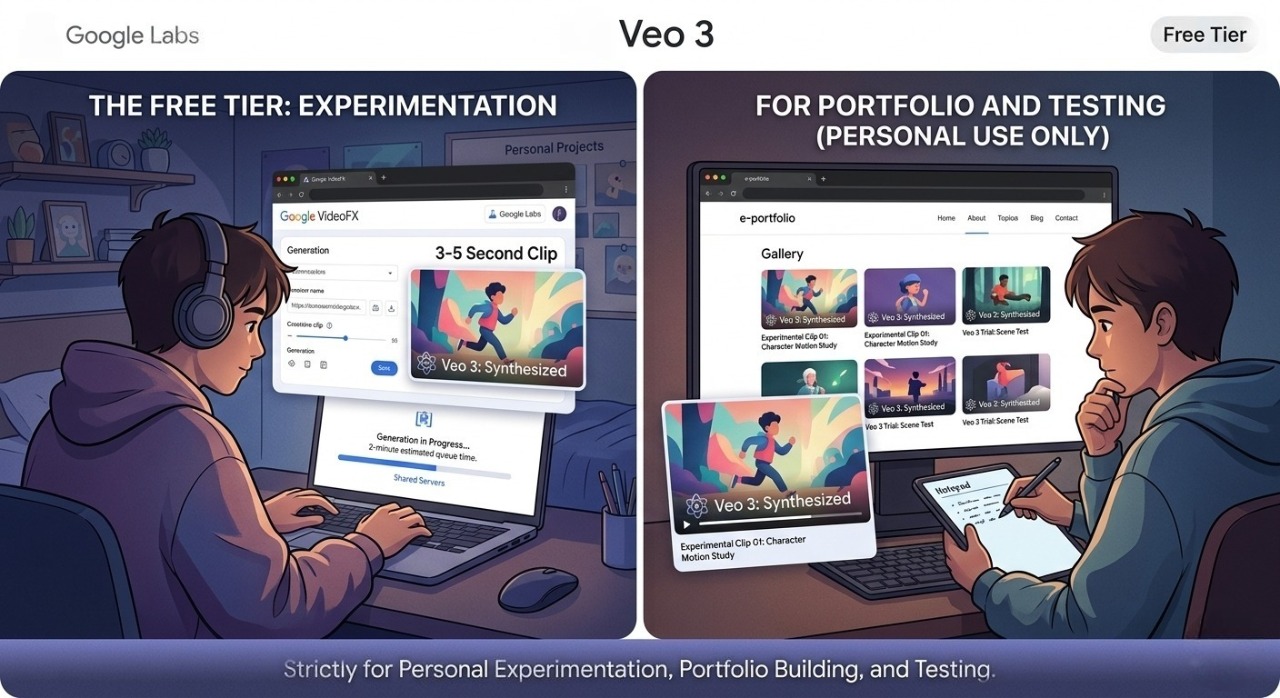
1. The Free Tier: Exploring the Capabilities
Google allows creators, developers, and AI enthusiasts to test Google Veo 3 for free through platforms like Google VideoFX (via Google Labs) or basic developer trial accounts in Vertex AI.
Generation Capabilities: Free users can generate standard length video clips (usually ranging from 3 to 5 seconds per generation).
Resolution & Quality: Access is typically limited to standard or capped high definition output, with a slight compression compared to the premium tier.
Rendering Speed (Queue Time): Free tier generations are processed on shared public servers. This means during peak hours, you will experience a queue, and your video might take a few minutes to render.
Watermarking: Videos generated on the free tier often include an embedded digital watermark (SynthID) to ensure responsible AI usage and transparency.
Commercial Use: Free tier generations are strictly for personal experimentation, portfolio building, and testing. They cannot be legally used in commercial advertising or monetized client projects.
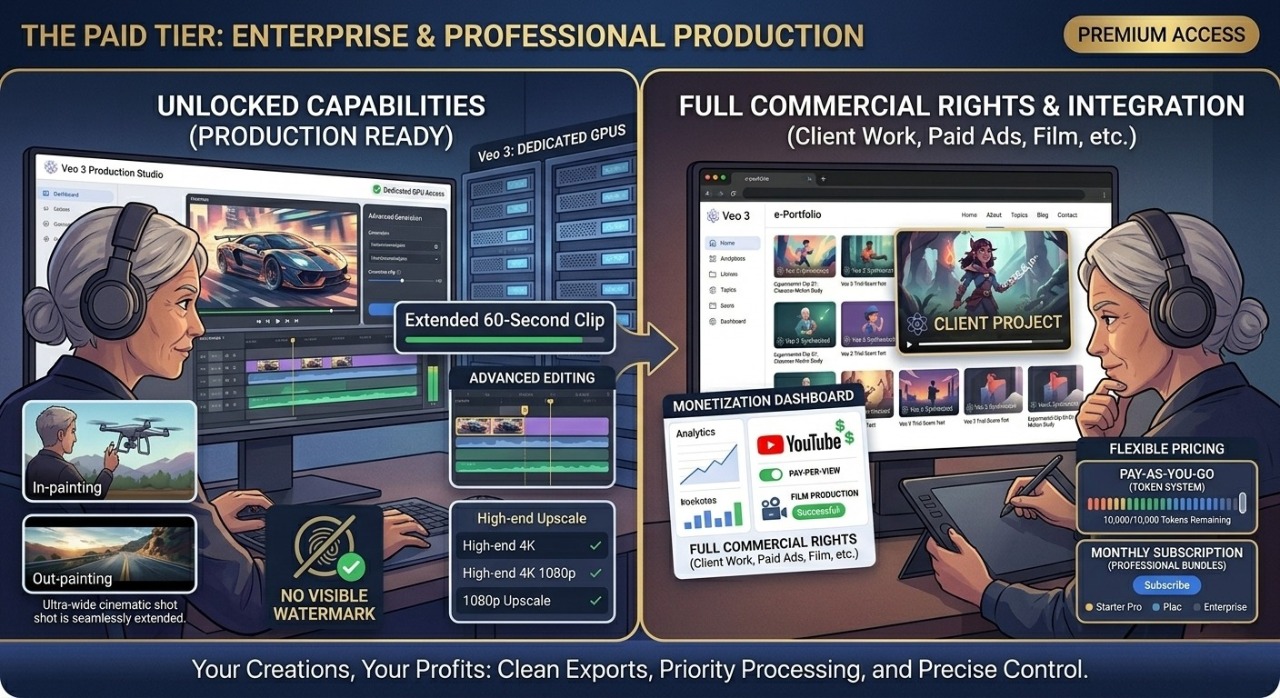
2. The Paid Tier: Enterprise & Professional Production
For agencies, professional video editors, and businesses, the paid tier of Google Veo 3 (available via Google Cloud’s Vertex AI API and premium creative suites) unlocks the full raw power of this model.
High-Speed Priority Rendering: Paid users get dedicated cloud GPU access. Your videos are rendered almost instantly with zero wait times in public queues.
Extended Clip Length & Up scaling: Paid models allow for longer initial clips, seamless video extensions, and access to premium 1080p and 4K up scaling tools.
Advanced Control Features: You get precise control over editing. This includes In painting (changing a specific object inside a generated video) and Out painting (extending the aspect ratio of a video without losing quality).
No Visible Watermarks for Production: While invisible safety metadata remains, paid tiers allow clean video exports ready for professional broadcasting and social media marketing.
Full Commercial Rights: Everything you create under the paid model belongs entirely to you, allowing you to use the videos for client work, paid advertising, YouTube monetization, and film production.
Flexible Pricing Models: Google offers a Pay-As-You-Go token system for developers using the API, alongside monthly subscription bundles for creators within Google’s creative suites.
Google Veo 3 vs. The Competition (Sora & Runway Gen-3)
When evaluating the power of Google Veo 3, it is essential to see how it stacks up against the heavyweights of the AI video generation industry, specifically OpenAI’s Sora and Runway Gen-3. While all three models offer mind-blowing capabilities, Google Veo 3 carves out a massive advantage through its deep integration with the Google Cloud ecosystem and its superior handling of complex cinematic physics.
OpenAI’s Sora has been a dominant name in terms of pure visual aesthetics, but access has remained restricted for many mainstream creators. On the other hand, Runway Gen-3 offers fantastic community driven tools and fine grained camera controls. However, Google Veo 3 outperforms both when it comes to long tail prompt adherence. Thanks to Google's advanced language models, Veo 3 understands complex, multi sentence creative prompts without dropping key details or mixing up character consistency. Furthermore, for businesses and developers already utilizing Vertex AI, Veo 3 provides a seamless, secure, and highly scalable pipeline that standalone platforms simply cannot match.
Conclusion: Is Google Veo 3 Worth It?
Google Veo 3 is not just another incremental update; it is a monumental shift in how digital video content is conceived and executed. The Free Tier serves as a magnificent sandbox for creators to hone their prompt engineering skills. However, for those looking to scale their production, eliminate wait times, and unlock commercial monetization, investing in the Paid Tier via Vertex AI is an absolute game changer.