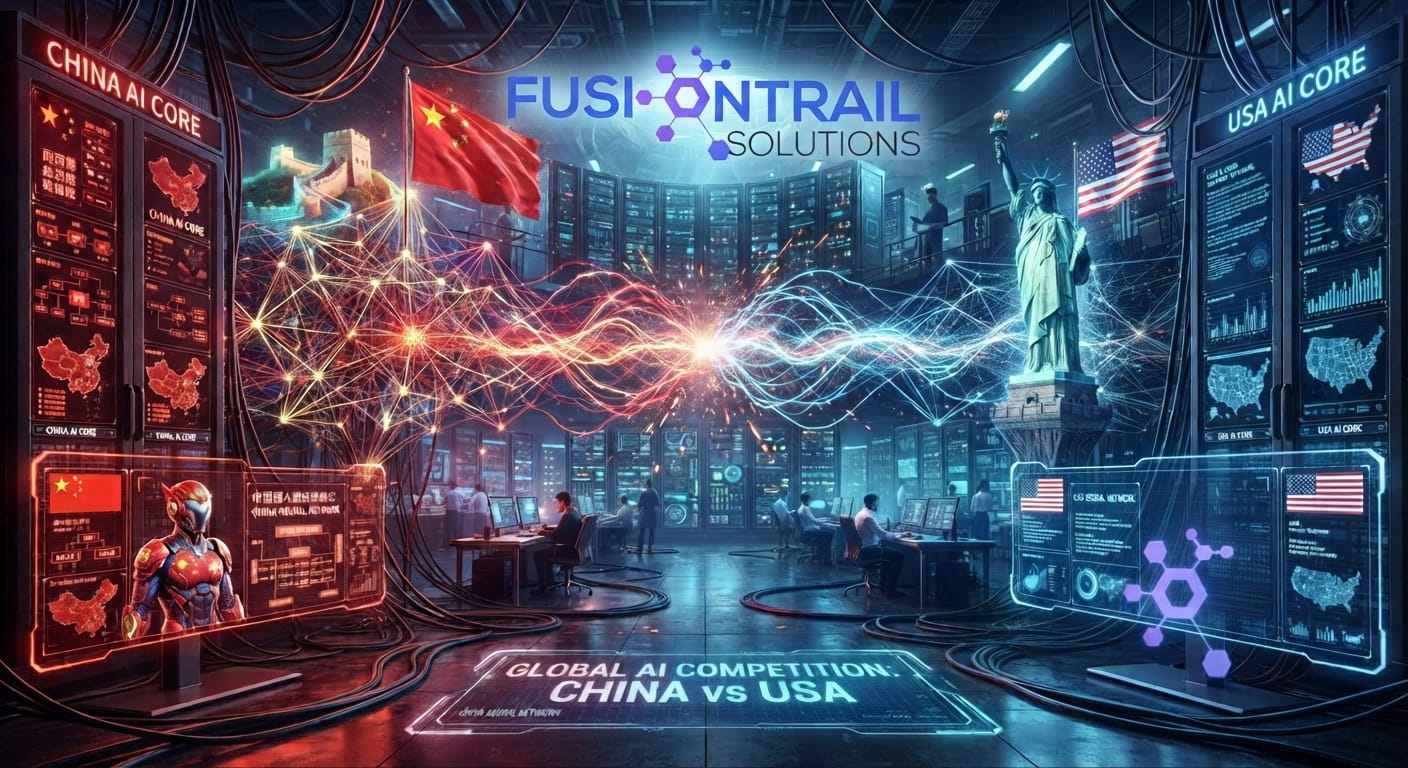
For years, the global artificial intelligence conversation seemed to have a simple storyline: the United States was building the frontier, while China was trying to catch up.
That storyline is becoming much harder to defend.
In 2026, Chinese AI companies are producing models that compete seriously in coding, reasoning, agentic tasks and other demanding workloads. Models from companies such as DeepSeek, Alibaba's Qwen, Z.ai's GLM and Moonshot AI's Kimi have turned China's AI industry into a major force in the global model market.
And the most interesting part is not simply that Chinese AI models are improving.
It is how they are competing.
The competition is increasingly about more than benchmark scores. It is about cost, open-weight models, developer adoption, computing infrastructure, chips, speed, reasoning, coding, AI agents and access to the global market.
So the real question in 2026 is no longer:
“Can China build powerful AI?”
The more interesting question is:
“How close can China get to the AI frontier — and what happens if the gap keeps shrinking?”
The China AI Story Is Bigger Than DeepSeek
When DeepSeek suddenly attracted worldwide attention, many people treated it as an isolated event.
But the Chinese AI ecosystem has continued producing new models.
Today, the conversation includes multiple major players:
StepFun
Tencent
ByteDance
Current model tracking shows several Chinese systems appearing high in global benchmark and evaluation datasets, including Qwen, Kimi, GLM and DeepSeek.
That matters because it suggests something broader than a single company's success:
China is developing an AI ecosystem, not just one famous AI model.
DeepSeek Changed the Conversation
DeepSeek became one of the biggest names in the AI industry because its progress challenged assumptions about how much computing power and money were required to build highly capable models.
And the company has not stopped.
According to a September 2026 Reuters report, DeepSeek's reported annualized revenue run rate reached $1 billion, more than doubling from a few months earlier. Reuters also reported that DeepSeek had released DeepSeek-V4.1-Flash, designed around improved capability, speed and scalability.
That does not mean DeepSeek has suddenly replaced every leading AI company.
It means something more important:
Chinese AI companies have demonstrated that they can move extremely quickly once a competitive research and engineering ecosystem is in place.
Qwen Is Turning Open AI Into a Serious Battlefield
Alibaba's Qwen ecosystem represents another important part of China's AI strategy.
Instead of competing only through a single consumer chatbot, Qwen has become part of a broader developer ecosystem involving models, APIs and open-weight releases.
Current independent model tracking places recent Qwen models among the strongest Chinese systems being evaluated globally.
This creates an interesting competitive advantage:
developers don't necessarily need to choose an AI model only because it comes from the biggest company.
They can compare:
performance
price
context length
reasoning
coding
deployment options
API costs
customization
licensing
infrastructure requirements
And that changes the AI market.
GLM, Kimi and the New Generation of Chinese AI
DeepSeek and Qwen may receive much of the attention, but they are not alone.
Z.ai's GLM models have become particularly notable for coding and agent-related workloads. A 2026 analysis from CSIS noted that GLM-5.2 performed near leading US closed models on coding and agent tasks.
Meanwhile, Kimi from Moonshot AI has also become an important Chinese model family.
This creates an unusual situation.
Instead of one company trying to challenge the American AI industry, multiple Chinese laboratories are developing competing approaches at the same time.
That could make the global AI race considerably more unpredictable.
So, Is China Ahead of the United States?
This is where the story becomes complicated.
There isn't one single leaderboard that can answer the question.
AI performance depends heavily on which model, benchmark, task, hardware setup, price and deployment method you are comparing.
Some Chinese models are now close to leading US systems on particular tasks. CSIS describes recent Chinese models as capable of competing with US models in many real-world applications.
At the same time, Chinese models do not lead every benchmark or every category.
And the distinction between open-weight and closed models matters.
So rather than saying “China has won” or “America has won,” the evidence points to a more complicated reality:
The gap has become much harder to ignore.

The Biggest Chinese Advantage May Not Be Raw Intelligence
Here is where things get really interesting.
The biggest competitive advantage for Chinese AI may not always be having the absolute highest benchmark score.
It may be cost and accessibility.
A September 2026 analysis citing Mozilla's State of Open Source AI report found that leading Chinese open-weight models were closing the capability gap with frontier US offerings while often being substantially cheaper to run. The report estimated the frontier gap at roughly four months using its methodology.
That creates a powerful combination:
Good performance + low cost + open weights + developer accessibility.
For startups and developers, that combination can matter enormously.
Open-Weight AI Could Change the Game
Imagine two AI systems.
One is extremely powerful but completely controlled by a company.
The other is slightly less capable on some tasks but can be downloaded, modified, fine-tuned and deployed on your own infrastructure.
For many developers, businesses and governments, those choices are not equivalent.
Open-weight models can provide greater control over:
deployment
customization
privacy
inference infrastructure
model fine-tuning
application architecture
operating costs
This is one reason Chinese AI models are attracting significant developer attention.
Mozilla's 2026 report found that Chinese-built open models were heavily represented among high-volume models on OpenRouter, although closed providers continued to capture the majority of model-layer revenue.
That distinction is crucial.
Popularity, technical capability and commercial revenue are not the same thing.
The United States Still Has Major Advantages
It would be a mistake to turn this story into “China is replacing America in AI.”
The US AI ecosystem still has enormous strengths.
American companies remain major players in:
frontier model research
AI infrastructure
cloud computing
developer ecosystems
semiconductor design
venture funding
AI products
enterprise adoption
And the competition is forcing US companies to respond.
A September 2026 Financial Times report described OpenAI and Anthropic introducing cheaper models amid intensifying competition, including pressure from cost-competitive Chinese models.
That tells us something important:
Chinese AI competition is affecting the economics of the global AI market.
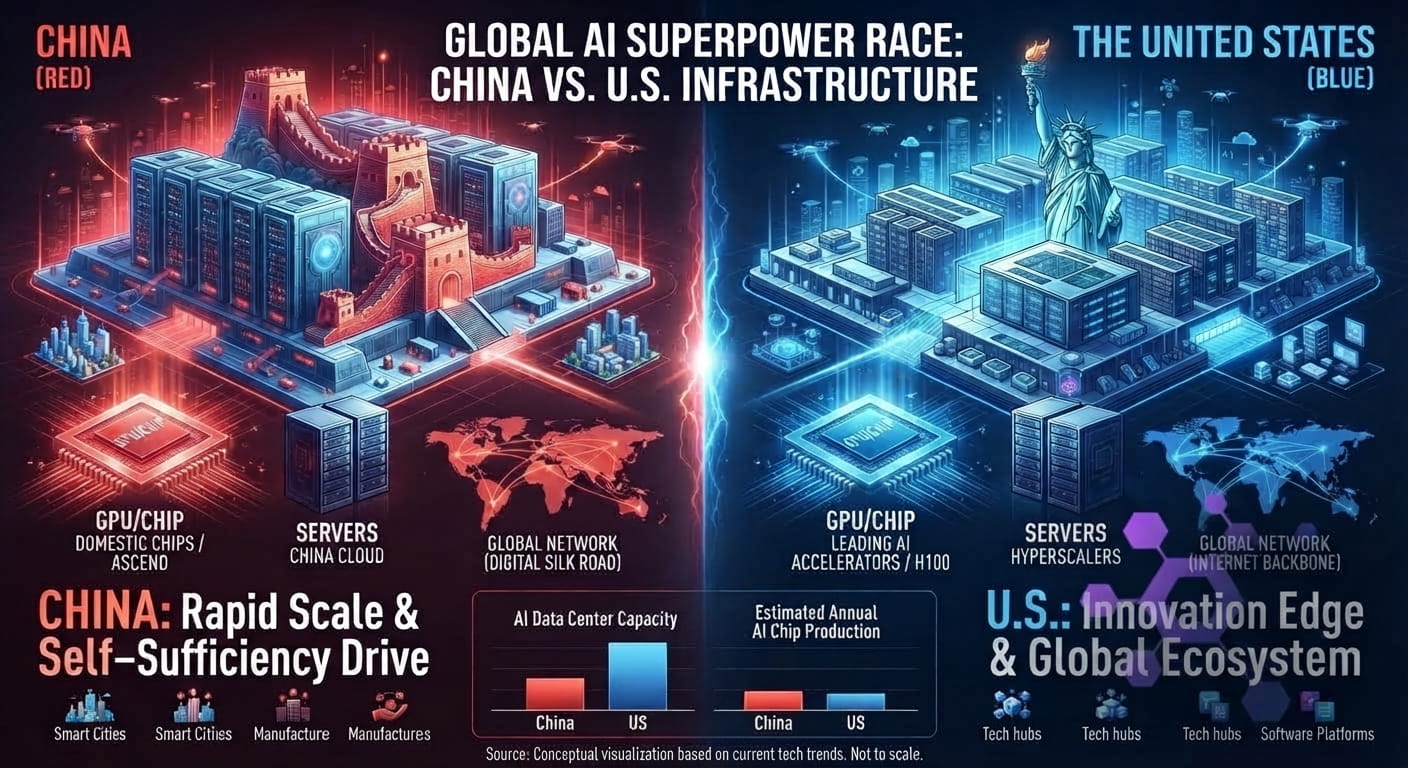
The Chip Problem Could Be China's Biggest Challenge
AI models are only one part of the equation.
Behind every frontier AI system is enormous computing infrastructure.
And this is where China faces significant constraints.
Advanced semiconductor manufacturing and access to cutting-edge AI accelerators remain major strategic issues. Chinese companies are developing domestic alternatives, but restrictions around advanced chips and manufacturing equipment create challenges for scaling AI infrastructure.
This produces an unusual situation.
China may be able to develop increasingly competitive algorithms and models while simultaneously facing constraints on the hardware required to scale them.
The outcome of that tension could become one of the defining stories of the next few years.
AI Is No Longer Just About Chatbots
Another major shift is happening underneath the chatbot race.
The next phase of AI competition is increasingly about AI agents.
Instead of simply answering:
“Write me an email.”
An AI agent could potentially:
understand a goal,
browse information,
write code,
interact with software,
analyze documents,
execute workflows,
monitor results,
and continue working with limited human intervention.
This is why coding and agent benchmarks have become increasingly important.
And Chinese models are already competing seriously in these areas.
The Real Battle: Price vs Performance
The AI industry may eventually discover that the biggest battle isn't:
Who has the smartest model?
It could be:
Who can deliver enough intelligence at the lowest sustainable cost?
Think about it.
If Model A is 5% better but costs 10 times more, many businesses may choose Model B.
If Model B is open-weight and can run on private infrastructure, the decision becomes even more complicated.
That is why Chinese AI's emphasis on efficient and cost-effective models could have effects far beyond China.
What Happens to Developers?
For developers, this competition is actually good news.
Instead of relying on one AI provider, developers increasingly have choices.
A modern AI application could potentially combine different models for different jobs:
DeepSeek for one workload.
Qwen for another.
GLM for coding or agent tasks.
Kimi for another workflow.
And US models for tasks where their particular capabilities are preferred.
The result could be a future where developers don't ask:
“Which AI company should I use?”
Instead, they ask:
“Which model is best suited to this specific task?”
That is a much more competitive AI market.
China AI vs US AI: What Are They Actually Competing On?
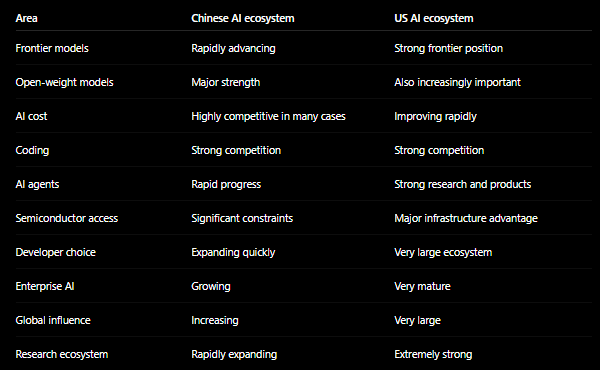
The important point is that there is no single metric that determines the entire AI race.
And Then There Is the Rest of the World
The biggest mistake would be to assume the future of AI belongs only to China and the United States.
Europe, India, the Middle East, Japan, South Korea and other regions are also investing in AI infrastructure, models and applications.
But China and the United States currently occupy a particularly important position because their companies and research ecosystems are producing many of the models driving the global conversation.
That makes the China-US AI competition important even for developers who live thousands of miles away from both countries.
The AI Race Is Becoming a Three-Way Competition
There is another way to look at the future.
The competition isn't simply:
China vs America.
It is increasingly:
1. Intelligence
Who can build the most capable models?
2. Economics
Who can provide that intelligence at the lowest cost?
3. Distribution
Who can get millions of developers and businesses to actually use it?
A model can win one category and lose another.
And that is why the next few years could look very different from the previous few years.
What Could Happen Next?
If the current trajectory continues, several trends are worth watching.
Smaller models could become much more powerful
Instead of requiring massive infrastructure for every AI application, efficient models may handle increasingly complex tasks locally or on relatively affordable infrastructure.
Open-weight models could become more important
Businesses may increasingly value models that can be customized and deployed independently.
AI prices could continue falling
Competition between providers creates pressure to deliver more intelligence for less money.
AI agents could become mainstream
The next major wave may come from systems that perform tasks rather than simply generate answers.
Hardware could become even more strategically important
The model race cannot be separated from the chip and data-center race.

So Who Is Winning the AI Race?
Perhaps the better question is:
What does “winning” actually mean?
If winning means having the strongest model on every benchmark, the answer can change depending on the test.
If winning means producing the cheapest capable models, the picture changes again.
If winning means controlling advanced AI hardware, the picture changes again.
If winning means getting millions of developers to use your models, the answer changes once more.
That is why the China-US AI competition is so fascinating.
The finish line keeps moving.
The Bigger Story
China's AI rise is no longer something the technology industry can dismiss as a distant possibility.
DeepSeek demonstrated how quickly expectations could change. Qwen expanded the open-model conversation. GLM and Kimi added further competition. Other Chinese companies are continuing to push into models, agents and AI infrastructure.
At the same time, US companies continue to invest heavily in frontier models, infrastructure and AI products, while responding to growing price and open-weight competition.
So the biggest story isn't simply China catching America.
It is that the global AI market is becoming dramatically more competitive.
And for developers, startups and ordinary users, that could be the most important development of all.
Because when powerful companies compete, the technology usually becomes:
faster.
cheaper.
more accessible.
and harder to ignore.
The next AI breakthrough may come from Silicon Valley.
It may come from Beijing, Hangzhou or another Chinese technology hub.
Or it may come from somewhere nobody is watching yet.
The AI race isn't over. In many ways, it is only getting started.
Which direction do you think AI is heading next — bigger models, cheaper models, open-weight AI, or autonomous AI agents? Share your view below.